Article contents 12 sections
To source 304 stainless steel smart locks, write the SUS304 requirement as a list of named parts, match each claim to evidence for that exact model, approve a sample against the same specification, compare quotations on the same scope and fix the approved configuration in the purchase order.
What a SUS304 Purchase Specification Must Cover
“304 stainless steel smart lock” can mean one handle, a visible escutcheon, some fasteners or most of the housing. A usable specification names the covered parts, the model and drawing revision, the finish, the environment and the documents needed for release.
SUS304 describes the material. Outdoor life, water protection, door fit and software each get their own line in the specification, and the material list, finish, construction, sample, quotation and purchase order all describe the same lock.
The sequence:
- Define the opening, environment, and component scope before requesting a quote.
- Tie each claim to the exact model, revision, and named part.
- Check the documents behind each claim before ranking quotations.
- Approve a physical sample against the same reference.
- Normalize commercial terms, then freeze the approved configuration in the purchase order.
- Recheck the revision and acceptance basis on repeat orders.
Who you buy from changes how much of this you can see; that choice is covered in manufacturer or trading company? and the smart lock factory audit checklist.
Start with the project and environment
Before comparing quotations, record the door and site conditions that change the specification:
| Project input | Why it changes the buying decision | Evidence or owner |
|---|---|---|
| Door type and opening schedule | Determines dimensions, handing, frame, strike, and installation interfaces | Door schedule and measured opening; engineering or installer |
| Indoor, sheltered, coastal, wet, or exposed location | Changes the corrosion, cleaning, drainage, and finish questions | Project environment statement; project engineer |
| Fire-rated, egress, or accessibility-sensitive opening | Requires responsible design and code review beyond material selection | Listing or approval scope and local reviewer/AHJ |
| Power, access method, gateway, and network assumptions | Determines whether the configured electronics and support model are suitable | Model configuration and project IT/security review |
| Target market and importer obligations | Determines labels, manuals, declarations, and applicable product rules | Market evidence file; importer/compliance owner |
Early prices are fine for budgeting; settle these points before choosing on price. A lower quote often covers fewer SUS304 parts, a different finish, fewer accessories or a configuration that misses the door.
Define the SUS304 component scope
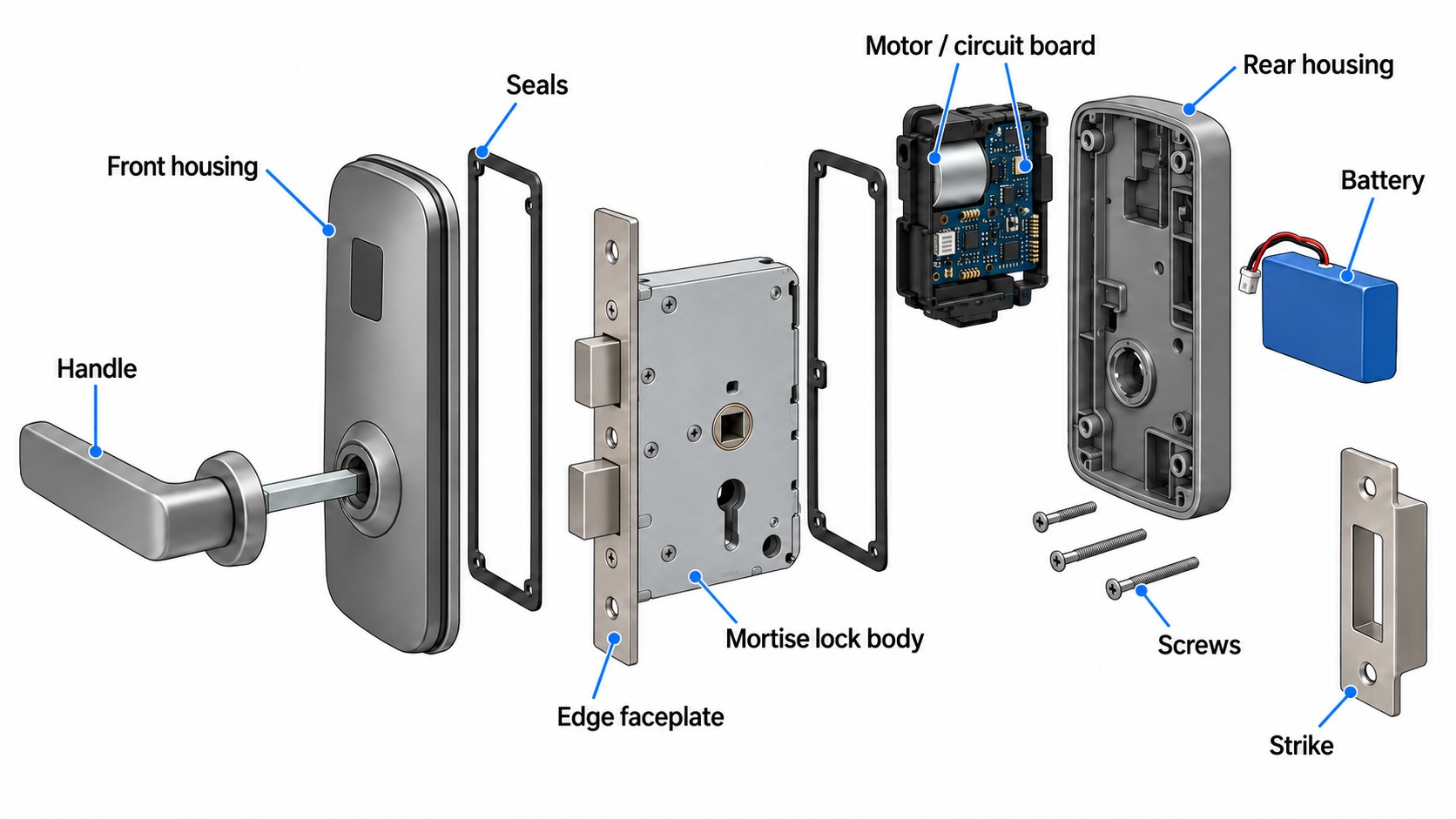
Write the material requirement as a part list. Typical objects include the exterior housing, front and back panels, handle, escutcheon or faceplate, latch, bolt, strike, screws and fasteners, internal mechanism, batteries, and accessories. State which parts must be SUS304 and which use another named material.
“Stainless steel” names a family; the grade is a separate line. The Japan Stainless Steel Association (JSSA) comparison table lists JIS SUS304 beside 304 and 1.4301 and notes that composition, mechanical properties and test methods differ slightly between standards. Use it as a cross-reference and name the standard your project requires.
| RFQ field | Example of a usable entry | Limit to state |
|---|---|---|
| Covered parts | “Front panel, rear panel, handle, faceplate, strike, and screws: SUS304” | Latch, bolt, internal drive and accessories are covered only if listed |
| Exclusions | “Latch and internal drive per approved mechanical drawing” | The exception must be visible and accepted |
| Finish | “Brushed finish, the agreed supplier finish code” | Finish appearance says nothing about alloy grade |
| Version | “the exact supplier model and drawing/BOM revision” | A family name covers several versions |
| Change rule | “No material, finish, dimension, electronics, label, or accessory substitution without written approval” | Approval of one sample covers that sample's configuration only |
Match evidence to the claim
Put grade, finish and construction on separate specification lines. Where thickness affects fit or stiffness, state it at defined points with drawing tolerances, and describe joints, seams and fasteners where they matter. The alloy grade says nothing about load capacity, wear or the strength of a thin part.
Each document does a different job. A manufacturer's statement records a claim. A material declaration covers a stated list of parts. A test report describes one tested sample, method and condition. A product certificate or listing has an issuer, scheme, object and scope. A management-system certificate such as ISO 9001 covers how an organization is managed; our Jinhua subsidiary obtained ISO 9001 and ISO 14001 certification in 2024, and neither says anything about the material of a lock part.
Keep a simple claim register: model and revision, part, claimed grade, document type, issuer, date, scope, conclusion and open check. A report for another model, finish, lot or assembly is background; release evidence covers the quoted lock.
Material identification and analytical limits
Handheld X-ray fluorescence (XRF) is a quick surface check on a clean, accessible part. It cannot measure carbon, and paint, plating or dirt distort the reading (Evident's XRF guidance). Bulk composition, welds and whole lots need a laboratory method such as spark emission analysis (ASTM E1086; ASTM E1476 covers grade verification and sorting). How to test a sample, and when to send a part to a laboratory, is in how to check SUS304 material claims on a smart lock sample. Our own SUS304 material test comes from an independent laboratory and names the material sample tested; a copy is available on request.
Corrosion and finish evidence
JSSA's guidance ties corrosion to grade, environment, surface condition, contaminants and use, and its finish table separates 2B, BA, No. 4, hairline, mirror and coated or colored surfaces. Record the finish separately from the grade: a coating hides the surface underneath, and polish says nothing about corrosion life.
ASTM B117 defines the apparatus, procedure and conditions for a salt-spray test. It sets no standard specimen or duration, and states that salt-spray results seldom predict behavior in natural service. Read the report itself: specimen, preparation, exposure time, evaluation criteria, replicates and how the sample relates to the ordered lock. Salt-spray hours compare constructions; they do not convert into years at a real site.
Approve the sample as a controlled reference
An exposed installation raises three separate questions: does the metal and finish tolerate the corrosion, does the enclosure keep out water and dust, and does the complete lock, electronics and batteries included, work in those conditions. A corrosion report answers only the first. The IP test report and operating limits of the exact configuration cover part of the other two; condensation, UV, power and the strike on site are checked separately.
The sample should carry the same model, revision, finish code, access configuration, and component scope as the quotation. Check dimensions that affect fit: door thickness range, backset, centers, faceplate, case depth, cutout, handing, frame, strike, and mounting pattern. Record measured values, photos with a scale, finish observations under consistent lighting, markings, accessory contents, and the document references used.
Keep a dated approval note with the approver, the retained sample or photos, accepted deviations and any open items with an owner.
Normalize quotations, MOQ, and trade terms
Check what the minimum order quantity (MOQ) applies to: the whole order, each model, each finish or the custom packaging run, and keep the production commitment separate from the shipment schedule. Compare the total commitment as well as the unit price.
Then put the quotations side by side on the same terms:
| Commercial field | Normalize this way | Common mismatch |
|---|---|---|
| Configuration | Same model, revision, finish, access method, firmware/app option, and accessories | One quote includes a gateway or spare parts and another leaves them out |
| Material scope | Same named SUS304 components and exclusions | “304 lock” is treated as whole-product coverage |
| Quantity and MOQ | State total units, units per model/finish, and packaging MOQ | A low unit price creates unwanted inventory |
| Price basis | Identify currency, tooling, artwork, samples, packaging, and taxes | Tooling or private-label charges are omitted |
| Delivery term | Name the Incoterms® rule, named place, shipment window, and transfer point | “FOB” or “door delivery” is used without a named place or version |
| Lead time | Separate sample, production, inspection, and transit | Production time is mistaken for arrival date |
| Acceptance | Link to approved sample, drawing, document package, and inspection plan | A commercial approval is mistaken for technical release |
ICC's Incoterms® introduction explains that the rules split delivery tasks, costs and risks between seller and buyer, while the product specification sits in the rest of the contract. Record the rule and named place, the insurance it requires and any extra cover, and who handles export, import, carriage, unloading and customs. MOQ is covered in MOQ and order quantity planning, and the cost beyond the unit price in unit price vs installed project cost and installation and commissioning cost.
Freeze the PO and control changes
The purchase order or its controlled annex should identify the supplier model code, buyer model name if different, drawing/BOM revision, SUS304 component list, finish, dimensions, electronics configuration, included accessories, packaging and labels, sample reference, required documents, inspection scope, quantity, MOQ, price basis, delivery term, and acceptance authority.
Require written approval for any change to material, finish, dimensions, latch or strike, electronics, firmware or app platform, labels, manuals, packaging or accessories. For a repeat order, compare the new quotation and sample with the last approved revision, since the same model code can hide a changed part, finish, label or carton.
Pre-shipment inspection checks a named lot against the PO, sample, drawing, packing instruction and sampling plan. List what the inspector checks: model and quantity, carton marks, visible finish, sample comparison, selected dimensions, accessory count, basic function, label match and document presence. Our quality and testing page shows what we check on every lock and how buyer inspections are arranged. Line-by-line quote comparison is in how to compare smart lock quotations, and the inspection itself in the pre-shipment inspection checklist.
Keep Product, Market and Project Evidence Separate
At receiving inspection, check the shipment identity, packaging, configuration, quantities, accessories, documents and agreed sampled characteristics against the PO. For a mismatch, name the affected units and record the outcome: an approved concession, rework or rejection under the agreed terms. The approved reference stays as it was.
Agree spare parts before the first shipment: which handles, strikes, cylinders, battery covers and electronic modules can be ordered separately, which installed revision they fit, and how you will hear about a discontinued or redesigned part. A similar-looking spare can still differ in fit or software. Budgeting for spares and replacements is covered in maintenance, downtime and replacement cost.
Separate the release file into:
- Product evidence: material declaration, component list, drawing/BOM revision, sample record, test reports, and inspection results.
- Market evidence: applicable certificates or listings, declarations, labels, manuals, and target-market requirements.
- Project evidence: door schedule, measured opening, installation review, fire/egress/accessibility review, handover, and responsible reviewer.
A document can belong in one file and mean nothing in another. ISO/CASCO's guidance on attestations of conformity centers on what is attested and who makes the statement: for any declaration, note who issued it, what it covers and whether an independent body assessed it.
Name the App Version on the Order
App access, gateway control, audit logs, remote authorization and application programming interface (API) access depend on the lock version, firmware or platform version, account setup, region and support arrangement. Tuya's developer documentation describes Bluetooth lock functions and gateway workflows, and TTLock's describes how a lock is transferred between accounts. Many of our models come in Tuya or TTLock versions, and some in a Local version without an app: the A2 IP66 waterproof smart lock has all three, while the G1 apartment smart lock, with its iron housing, comes in TTLock or Tuya Wi-Fi. The model page lists the options, and the order names the version. Record the confirmed model, software version, data responsibilities, update path, administrator roles, and support contact without placing passwords or secret keys in the procurement file.
Fire-Rated and Other Regulated Openings
On fire-rated, egress, accessibility-sensitive or otherwise regulated openings, the complete opening design and its responsible reviewer decide acceptance; the stainless housing is one input. The listing, power state, control sequence, installation details and local authority requirements are reviewed separately.
We quote SUS304 orders against the door list, environment, quantity and part list, with the proposed model, housing material and lock body named on the quotation. For private-label orders, see OEM/ODM.
Frequently Asked Questions
Is SUS304 the same as 304 or 1.4301?
They are corresponding grades, close enough to cross-reference, but each is defined in its own standard. The grades are: SUS304 in Japan (JIS), 304 or UNS S30400 in the United States (ASTM/AISI), 1.4301 in Europe (EN) and 06Cr19Ni10 in China (GB). Their chemical limits are close but not identical, and the test methods differ. Name the standard and grade your project requires; our SUS304 page lists the corresponding grades.
Does a 304 stainless smart lock mean every part is stainless steel?
No. On most of our models the SUS304 parts are the front and rear housings, often with the handle and faceplate. The lock body internals, springs, screws, seals and electronics use materials chosen for their job. Write the requirement as a list of named parts and have each one confirmed on the quotation. See does a SUS304 smart lock mean every component is stainless steel?
Can a handheld XRF test prove a lock is 304?
It can show whether the chromium and nickel at a suitable, clean measurement point match a 304-type steel; the test provider chooses the point and any preparation. It cannot measure carbon, so it cannot tell 304 from the low-carbon 304L, and paint, plating or dirt distort the reading. It also tests only the surface of the part you scan. For a dispute, send the part to a laboratory method such as spark emission analysis. See how to check SUS304 claims on a sample.
How many salt spray hours does a 304 smart lock need?
There is no required number: salt-spray hours do not convert into years outdoors, and ASTM B117 itself states that results seldom predict natural exposure. Read the report for which part and finish were tested, for how long and what counted as a failure, and use it to compare constructions. Our corrosion resistance page explains how to read these reports.
What should a SUS304 smart lock purchase order specify?
The model code and drawing or BOM revision; the list of SUS304 parts and any agreed exceptions; finish, lock body, electronics version and accessories; packaging and labels; the approved sample reference; required documents and inspection scope; quantity, price basis and the Incoterms® rule with its named place; and a rule that no material, finish or component changes without your written approval.
References
- Japan Stainless Steel Association: comparison of JIS and foreign standards — related grade designations and limitations on equivalence.
- Japan Stainless Steel Association: stainless-steel surface finishes — finish descriptions, separate from alloy grade.
- Japan Stainless Steel Association: corrosion and corrosion phenomena — passive films, environmental influences, and localized corrosion.
- ASTM B117 (current edition B117-26a) — public scope and significance of salt-fog testing, including limits on predicting natural exposure.
- ASTM E1476 — public scope of metals identification, grade verification, and sorting.
- ASTM E1086-22 — public scope and specimen conditions for spark atomic-emission analysis.
- Evident: considerations when using XRF for PMI — elemental coverage, surface condition, and measurement geometry.
- ISO/CASCO: Attestations of conformity — assessment objects, first-party declarations, and third-party certification.
- ICC Digital Library: Incoterms® introduction — allocation of delivery obligations, costs, and risks; matters requiring separate contract terms.
- Tuya Developer: Bluetooth lock functions and TTLock: Transfer Lock — platform workflow examples; availability on a particular lock requires model-specific confirmation.