Article contents 14 sections
A smart lock pre-shipment inspection checks eleven things against the approved order: shipment identity and quantity, product identity, appearance, critical dimensions and the installation kit, mechanical operation, electronic access, power and connectivity, the digital delivery state, labels and documents, packaging, and the handling of any findings. The checklist table below lists what to check and what to keep for each.
The report should answer three questions: Are these the locks we ordered? Do the inspected units meet the agreed requirements? Is the shipment ready to leave in its present condition? It also shows how samples were selected, which checks were done and what happens to nonconforming goods.
What a Pre-Shipment Inspection Should Establish
Pre-shipment inspection, often shortened to PSI, examines goods before dispatch against specified requirements. Inspection providers commonly include quantity, workmanship, dimensions, function, marking and packaging in the scope. QIMA's published service description lists these categories and the resulting photographic and pass/fail report. QIMA pre-shipment inspection
For smart locks, follow the whole delivered assembly. A correct front panel can be packed with the wrong mortise, spindle, cylinder, cable or instructions, and a unit that works on test can still be bound to a factory test account that blocks the buyer from commissioning it.
So the inspection covers both the physical kit and the agreed digital delivery state. The report separates what was tested on sampled units from what came from records, and lists anything left unchecked.
PSI finds shipment-specific problems while they can still be corrected. Product development tests, factory audits and commissioning on the final door each happen at their own stage. Functional test cases for the sampled units are set out in smart lock functional inspection: test cases for a shipment.
The Smart Lock Pre-Shipment Checklist at a Glance
Use this as the inspection structure. Each row needs an agreed scope and acceptance basis, and rows can use different sample counts.
| Inspection area | What to check | Evidence to retain |
|---|---|---|
| Shipment identity and quantity | PO, configurations, production status, carton count and quantity by variant | Packing list reconciliation and photographs of the identified goods |
| Product identity | Model, finish, lock-body option, handing, hardware and software identifiers | Sample-unit identifiers and comparison with approved records |
| Appearance and assembly | Surface condition, assembly gaps, loose parts, sharp edges and damaged connections | Defect photographs with location and scale where useful |
| Dimensions and installation kit | Agreed critical dimensions, spindle/cylinder options, strike, screws, cables and templates | Measured values and kit comparison |
| Mechanical operation | Handle, latch, bolt, key and inside operation for the ordered function | Test conditions and observed movement |
| Electronic access | Ordered credentials, denied access, locking sequence and indications | Expected versus observed results for each tested function |
| Power and connectivity | Startup, low-power and backup checks, local and connected operation | Power setup, network conditions and limitations |
| Digital delivery state | Test credentials, account binding, configuration and agreed commissioning state | Post-test restoration check without exposing secrets |
| Labels and documents | Product-to-box mapping, identifiers, barcode content, language and instructions | Readings, label photographs and document revisions |
| Packaging and dispatch condition | Contents, protection, carton condition, shipping marks and repacking | Pack photographs, sampled dimensions/weights and closure record |
| Findings and disposition | Defect classification, counting, incomplete checks and correction status | Original report, correction evidence and shipment decision |
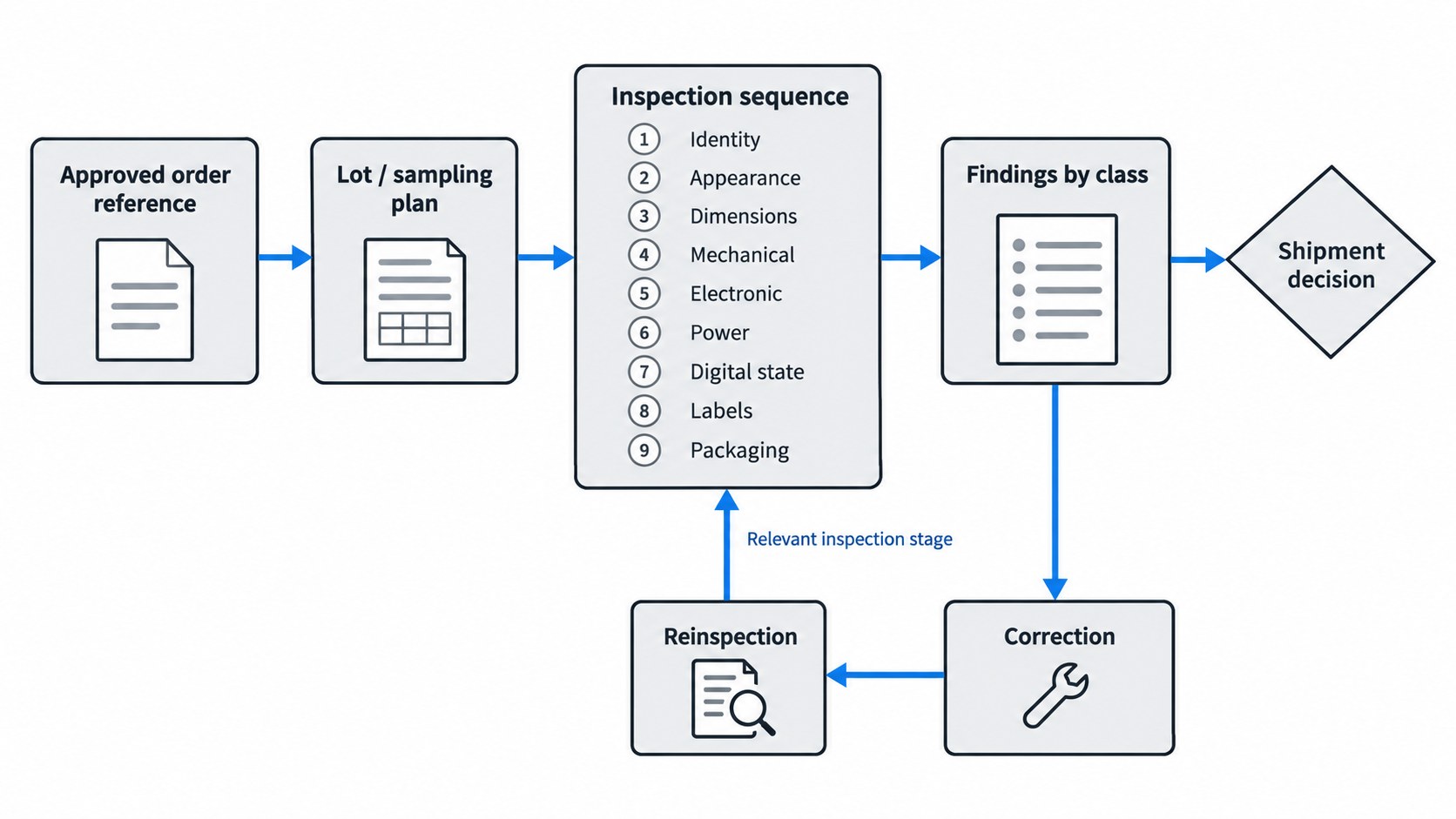
Prepare the Order Reference Before the Inspection
Give the inspector a short set of approved documents instead of the email history: purchase order, quantities by configuration, packing list, product specification, drawings, packing contents and the approved appearance reference.
Include the test methods, expected results, sampling plan, defect definitions and any separate conditions that must be satisfied before shipment. If a feature was removed or changed after sample approval, supply the approved change as part of the reference set.
A reference sample shows finish and assembly; pair it with written specifications for concealed options, dimensions, software configuration and kit contents. If the sample and the current order disagree, settle that point before the visit.
Make each configuration distinguishable
Describe each variant precisely. “Black smart lock” covers too much when the shipment holds different lock bodies, door-thickness kits or connectivity options: our A2 IP66 waterproof smart lock alone takes four mortises and comes in Local, Tuya and TTLock versions. Two units can share a housing and need different spindles and screws, so the inspector tells each variant and its carton contents apart as well as counting accessories. In a 2024 order of 1,500 gate locks, 600 had a spindle 5 mm longer than the other 900; we ran them as two marked sub-versions and checked the carton marks, packing lists and accessories for each group (quality and testing).
The factory lists any units that are unfinished, under repair or awaiting packing, so they stay out of the finished-goods total.
Agree when the goods are ready to inspect
Inspection visits can happen before every unit is finished or packed. Record the quantities available and what the visit covered; goods finished afterward are outside that result.
For the dispatch decision, account for the full shipment quantity. If the visit covered part of it, say how the rest will be checked. Packaging still flat on the pallet is reported as uninspected.
Leave time for functional checks, correction and repacking. Testing while the truck is loading loses sample identity and hides intermittent failures.
Define the Lot and Sampling Plan
A shipment is a logistics grouping; an inspection lot is the group the acceptance decision applies to. A container with several configurations or production batches usually holds several lots.
Set the lot boundaries by configuration, revision and production batch before selecting units.
NIST describes acceptance sampling as using a random sample to decide what happens to a lot; its purpose is the accept-or-reject decision, and it gives no estimate of the lot's quality. NIST: What Is Acceptance Sampling?
Record the complete plan, not just an AQL value
An AQL value does not say how many units to examine or when to reject the lot. The written instruction does:
- The lot and its size, and the unit being counted.
- The sampling method or standard and its edition.
- Inspection level, plan type and severity, where the system uses them.
- Sample sizes and acceptance/rejection criteria for each class or check.
- How units and cartons will be selected, including variant coverage.
- Treatment of destructive tests, incomplete tests, repeat tests and rejected lots.
ANSI/ASQ Z1.4 is an attribute sampling system with normal, tightened and reduced plans and switching rules for a continuing stream of lots, and ASQ separates counting nonconforming units from counting nonconformities per 100 units. Use the system with its rules as well as its sample-size table. ASQ: Z1.4 and Z1.9
A quality specialist or inspection provider can draft the plan for buyer and factory to agree. Settle it before the results are known.
Select samples from the available lot
The inspector picks from the goods named in the plan, never from a tray of demonstration units, and records the cartons and units selected so each observation traces back to the lot.
Give access across storage locations and configurations, since the easiest cartons can miss differences elsewhere. Extra targeted checks on a risky variant are labeled separately from the random sample.
Record how many cartons were opened, how many complete kits were examined and how many units got each functional test. “Sample size 80” is incomplete if only some of them were powered up.
Understand what AQL does—and does not—mean
AQL is a parameter of a sampling system, not a permission to pack a percentage of defective locks. Every sampling plan carries a risk of rejecting a good lot and of accepting a bad one; NIST calls these the producer and consumer risks. NIST: Types of Acceptance Sampling Plans
A clean sample means the lot passed the plan; uninspected units can still carry defects. Where a characteristic needs more assurance, specify production controls or 100% screening for it, because a final sample only measures what the process already made. Our factory checks every complete lock for its functions, appearance and accessories before packing, which is the 100% layer under any buyer's sample.
Set Defect Classes Before Counting Findings
Classify each defect by its consequence in use and against the agreed specification, in a defect catalog written for this lock and order. A typical structure:
| Class | Basis for the agreed classification | Example smart lock finding |
|---|---|---|
| Critical | A defined serious safety or security consequence requiring immediate action | Failure of an essential inside-release function in the specified safety-related configuration |
| Major | Material loss of operation, installation, completeness or specified performance | Missing required spindle, repeated failure of an ordered access method, or incompatible supplied strike |
| Minor | A limited departure within the catalog's lower-severity criteria, with the lock still fully usable | A cosmetic blemish that exceeds the agreed minor appearance limit |
| Separate discrepancy or incomplete check | A question requiring resolution outside the ordinary defect tally | Unverified quantity, an unexplained software version or an unavailable required test setup |
Wrong handing, wrong labels or a software-version mismatch can be anything from a quick fix to a serious loss of function, so describe the consequence and classify by the catalog.
A commercial mismatch can stop a shipment with no safety issue at all, and one serious safety finding outweighs a low cosmetic count. Keep these decisions visible instead of folding everything into one percentage.
Count defects and affected units consistently
One lock can have several nonconformities. Record each finding, then calculate the acceptance tally using the rule chosen in the plan.
Take three inspected locks: the first has a missing spindle and a damaged cable, the second has a missing spindle, and the third has a cosmetic blemish. That is four observations on three affected units. If the two installation problems are classified as major, there are three major observations on two units with major nonconformities.
A unit-based plan and a nonconformity-based plan use different counts, so keep the detailed observations behind the summary.
Inspect the Shipment in a Repeatable Sequence
1. Reconcile quantity and physical identity
Compare the purchase order and packing list with the goods. Record finished, packed, unpacked and unavailable quantities separately, and mark which counts are physical and which come from carton markings.
Follow outer carton to box to unit and check that the markings match the product inside. Where serial numbers or device IDs are required, look through the mapping for duplicates and gaps.
With several variants in one shipment, check quantity and kit allocation per variant; the right branding outside can hide mixed contents inside.
2. Examine appearance and assembly
Use the agreed lighting and appearance reference. Inspect surfaces, edges, buttons, display windows, readers, handles, cylinder covers and battery covers, and record where each scratch, dent or finish difference is and how large; “poor appearance” gives the factory nothing to fix.
Check for loose parts, uneven seating, damaged threads, missing fasteners and trapped or damaged wiring where accessible. Tell dirt from damage, and record the condition before cleaning.
Photograph each finding close up and in context, with a scale where an appearance limit is measured.
Open sealed assemblies only with an agreed method, scope and restoration procedure.
3. Verify critical dimensions and installation parts
Measure the dimensions that matter to the order: for example, faceplate geometry, backset, operating-center spacing, mounting-hole positions, spindle length or cable length. Record the reading, the reference points and the limit.
Use tools that resolve the tolerance (calipers for a ±0.5 mm limit; a ruler is too coarse), with the calibration the instruction requires.
Compare the installation kit with the approved list: cylinder, keys, spindle, strike, screws, gaskets, cables and adapters. A bag with the right number of pieces can still hold the wrong lengths.
The mortise, backset and lock body guide explains these interfaces. PSI checks the shipped configuration against the approved order. Fit on each actual door is checked separately, against the door survey and installation requirements.
4. Check mechanical operation on the specified setup
Use a fixture or sample door suited to the ordered assembly, with the specified mating components. Record the door-thickness representation, handing, spindle, cylinder and receiving arrangement where they affect the test.
Operate the handle, latch, deadbolt, key and inside release that the lock has. Watch movement, return and engagement against the required function, first with the mechanism free and then, where the scope includes it, with the bolt or latch engaging the specified strike.
Engagement needs a receiver: a bench test without a strike shows free movement only. A misaligned fixture can also add resistance, so record the setup and keep the original observation while you check the fixture.
Set the number of operations before testing. A few cycles check function; endurance comes from cycle testing on representative samples, which our factory runs on aging and cycle-test stations.
5. Check electronic access and the physical result
Test the access methods ordered for the configuration: PIN, card, fingerprint, face, app or key, as the model has them. Enroll temporary test credentials through the authorized procedure and record which methods were exercised.
For each method, watch the physical result as well as the authorization: a beep, green light or app message indicates authorization, and the inspector still checks that the bolt or latch moves.
Include denied-access and credential-removal checks where the plan calls for them, and record the sync conditions under which a revoked credential stops working.
Check the locking sequence: handle action, manual locking or automatic relocking, with any door-position input or calibration. Run automatic bolt movement only on a suitable fixture.
Biometric checks confirm the sample enrolls and works; false-acceptance rates and spoof resistance come from separate testing.
6. Check power and connectivity under defined conditions
Use the specified battery type or regulated supply, polarity and operating range. Record the test supply and the battery condition so a later investigation can reproduce the setup. On our locks a low battery can light the panel but not move the motor, so a lit panel says little about the supply.
Test low-power warnings, backup power and power-loss behavior only with an agreed procedure; stress tests such as short circuits or out-of-range voltages stay out of routine inspection. Our smart locks have a mechanical key and a 5 V Type-C port for emergency power, so the backup check covers both. Without the right equipment, mark the check incomplete.
For connected features, state whether the test uses a direct local connection, a gateway or an internet-dependent service. Record the app, firmware and gateway configuration without exposing account secrets.
Where offline operation or reconnection is required, test the transition. On our locks, fingerprints, PINs and cards already enrolled keep working within their validity when the network is down, and remote changes need the connection; the report names which function and path were affected.
Test platform features on the shipped configuration: a brochure lists what the platform can do, not what this configuration does. Radio coverage at the site is checked at the site, on its own network.
7. Restore the agreed digital delivery state
Testing changes the product: it adds credentials, binds locks to accounts, alters settings and leaves test records. So the inspection ends by restoring the agreed commissioning state.
NIST's IoT capability baseline lists authorized configuration changes, restoring a secure configuration and data protection as device capabilities; the reset itself follows the product's own procedure. NISTIR 8259A
Remove test access, release test-account and gateway bindings, and check the result: a local reset can leave a cloud-side link in place. For an order supplied preconfigured, keep the buyer's configuration. On our locks a factory reset deletes the administrator and every user, and on app versions the lock then has to be added to an account again, so a customer-provisioned lock is restored by removing the test entries, not by a reset.
Keep passwords, active access codes, biometric records and sensitive credential images out of the general inspection report. Record that the restoration check was completed and how it was verified, without reproducing the secrets used.
8. Match labels, identifiers and instructions to the unit
Compare the product label, individual box, outer carton and packing list with the actual configuration. Check the required model description, finish, variant, quantities, language and other agreed information.
For barcodes and QR codes, compare the decoded data with the required value; a code that scans can still name the wrong variant. Where the order needs formal print-quality grading, that is a separate verification.
The instructions, templates and accessory sheets should describe the supplied hardware and setup; a manual in the right language can still show a different wiring, lock body or reset.
PSI checks that the specified conformity markings and documents are present and consistent. Whether they cover the product is reviewed with the certificate and document review guide.
9. Inspect packaging and restore opened packs
The approved protection should separate surfaces and restrain heavy or sharp components. Look for screws, keys or lock bodies that can move against finished panels, and unsupported parts that can press against a reader or display.
Compare the packing arrangement, carton condition and shipping marks with the specification. Record sampled carton dimensions and weights where required, and follow up real differences; a carton at the right weight can still be missing a spindle.
Note what will ship, including whether batteries are included and how. Battery preparation, marking and documents are checked against the approved shipping instruction.
Drop, vibration and other transport tests, if ordered, have their own procedure and sample.
After inspection, restore the correct contents, protection and closures of every opened pack. Reconcile keys and accessories with their units, remove temporary labels that conflict with the shipping marks and record units retained or consumed for testing. Label, barcode and carton checks in more detail are in smart lock packaging and label inspection before shipment.
Record Failures So They Can Be Investigated
A good finding links one observed departure to a requirement and an identifiable sample. Record the unit or carton, test step, expected result, actual result, conditions and evidence reference. Add the defect class from the agreed catalog and keep any proposed cause separate from the observation.
For example, “motor defective” states a diagnosis. “Authorized unlock indicated, but bolt remained extended on the third operation using the recorded fixture and supply” states an observation that can be investigated.
Keep intermittent failures: an earlier failure stays on the record after a later success. Record the sequence, any adjustments and the repeat-test instruction, and if the test itself was invalid, record why and keep both entries.
Use four statuses: pass, fail, not tested and not applicable. An unavailable gateway test is “not tested”: it counts neither as a fail nor as a pass.
A worked example of a sampling decision
Take an instruction that calls for 50 units to be inspected for a defined class of nonconforming units, with an acceptance number of 2 and rejection at 3.
If three different sampled units have qualifying failures, the lot fails. Repairing those three units does not change the result: the factory corrects the lot, and acceptance follows the agreed reinspection process.
NIST separates plans that allow a second sample from single-sample plans; drawing extra units after a failure only counts when the plan provides for it. NIST: Types of Acceptance Sampling Plans
Separate the Inspection Result from the Shipment Decision
The inspector reports conformity within the agreed scope and the sampling result. The person authorized under the purchase agreement then decides on the shipment, including open items outside the defect tally.
| Result or condition | Appropriate next action | Record needed |
|---|---|---|
| Required checks completed and criteria met | Consider release of the identified goods | Inspection report and authorized shipment decision |
| Sampling rejection or a defined stop condition | Contain the affected goods and investigate correction | Failure record, affected scope and corrective action |
| Required test or identity check incomplete | Obtain the missing evidence or complete inspection | Explicit outstanding item and closure evidence |
| Correctable mismatch addressed after inspection | Check the correction and its wider effects | Rework/repacking record and follow-up results |
| Buyer accepts a permissible commercial deviation | Document the specific concession without rewriting the observation | Authorized deviation describing scope and conditions |
A concession can accept a commercial deviation, never an unsafe or unlawful configuration. Record exactly what was accepted; the inspection report stays as written.
For a partial release, list the released and retained cartons and reconcile the quantities. It works when the goods can be cleanly separated and the sampling scheme allows it.
Correct the Affected Lot, Then Reinspect the Defined Scope
Start with containment: keep the affected goods identified and out of the shipment, keep the failed samples, and find out how far the issue extends beyond them.
The corrective action states what was found, which goods were affected, what was changed and how it was checked, often by screening every unit for that specific fault.
Plan reinspection around the correction and its consequences. A replaced cable needs functional checks and a look at whether assembly trapped the new cable. Relabeling means checking the unit-to-box mapping again. Repacking can disturb key allocation or accessory completeness. A software change can affect the operating sequence and delivery state. At our factory a nonconforming lock is taken out of the release route, corrected and checked again; if the issue can affect a batch, we trace it through production and components, and our head of quality holds the batch until corrective action and reinspection are complete.
A retest of repaired units and a new lot acceptance are two different checks. The new acceptance sample is drawn by the agreed procedure from the whole corrected lot, repaired units included.
Keep the first report and issue a linked follow-up record. QIMA likewise describes corrective action followed by reinspection as a route after an unsuccessful PSI. QIMA pre-shipment inspection
What the Final Inspection Report Should Contain
The report has to make sense to someone who was not there. It needs the identified shipment, order reference, inspection date and location, available quantities, configurations and approved reference revisions.
Show the sampling method and actual counts by check, the measured results, functional conditions, findings, photographs, acceptance calculation and incomplete items. Note any factory intervention during inspection, such as replacing a battery, adjusting a fixture or exchanging a component.
Finish with the inspection conclusion, required actions and the separate shipment authorization where applicable. If packing or contents change afterward, review the effect on the report's coverage before dispatch.
Container loading checks, where needed, are a separate visit covering carton identity, quantity and loading condition.
Keep Shipment Checks Separate from Long-Term Performance Claims
Service life, IP rating, alloy grade and corrosion performance come from test reports and material records; a few operating cycles or a visual check say nothing about them. What PSI does check is that the shipped configuration matches the one those documents cover; where it differs, record the mismatch. Our IP ratings are model-specific: the A2 is IP66 and the G1 apartment smart lock IP55, so a shipment mixing them needs both reports.
On safety-related openings, PSI checks the ordered hardware; it does not replace the project review or the acceptance of the installed opening. For door-factory and project supply, see project door smart locks.
Reading those documents is covered in how to read an IP test report, matching a certificate or test report to the model and test report vs certificate vs declaration.
Make the Checklist Part of the Purchase Specification
Agree the inspection basis while the order is defined, and update it for approved changes, so the factory can prepare the references, fixture, power setup, connected-test access and packing records in time. Name any check that needs special equipment, extra time or separate test samples before the visit is booked.
A clearly specified shipment is easier to inspect, compare and receive than one defined only by a product photograph.
Frequently Asked Questions
Does every lock need to be tested during PSI?
No. The agreed plan sets the sample and any checks that need 100% screening. Our factory checks every complete lock before packing; the buyer's acceptance sample comes on top of that.
What AQL should be used for smart locks?
Agree it per order, with separate values for each defect class, together with the sampling system, inspection level and decision rules; we can base the plan on ISO 2859-1. The AQL number is one line of that instruction.
Does passing an AQL inspection mean the shipment has no defects?
No. It means the lot passed the selected plan. Uninspected units can still have defects, and known defective units are never shipped.
Can a pre-shipment inspection confirm waterproofing or fire-door suitability?
No. Those come from IP testing, certification scope and the installed-opening review. PSI checks that the shipped configuration matches the documents.
References
- QIMA — Pre-Shipment Inspection. Published inspection scope, reporting and follow-up inspection context.
- NIST/SEMATECH Engineering Statistics Handbook — What Is Acceptance Sampling?. Random lot sampling and the distinction between acceptance decisions and quality estimation.
- ASQ — ANSI/ASQ Z1.4 and Z1.9. Attribute-sampling systems, switching rules and alternative counting bases.
- NIST/SEMATECH Engineering Statistics Handbook — Types of Lot Acceptance Sampling Plans. Single and multi-stage plans, acceptance numbers, and producer and consumer risks.
- NISTIR 8259A — IoT Device Cybersecurity Capability Core Baseline. Device configuration and data-protection capabilities.