Outdoor Smart Lock Durability
Before you choose a lock for an exposed door or gate, check what it will face. Outdoor smart lock durability depends on more than a waterproof rating: rain, sun, cold, dust and salt each act on a different part, from the housing seals and the finish to the batteries and the bolt meeting its strike. Start with what IP55 and IP66 cover, then work through the conditions at your site.
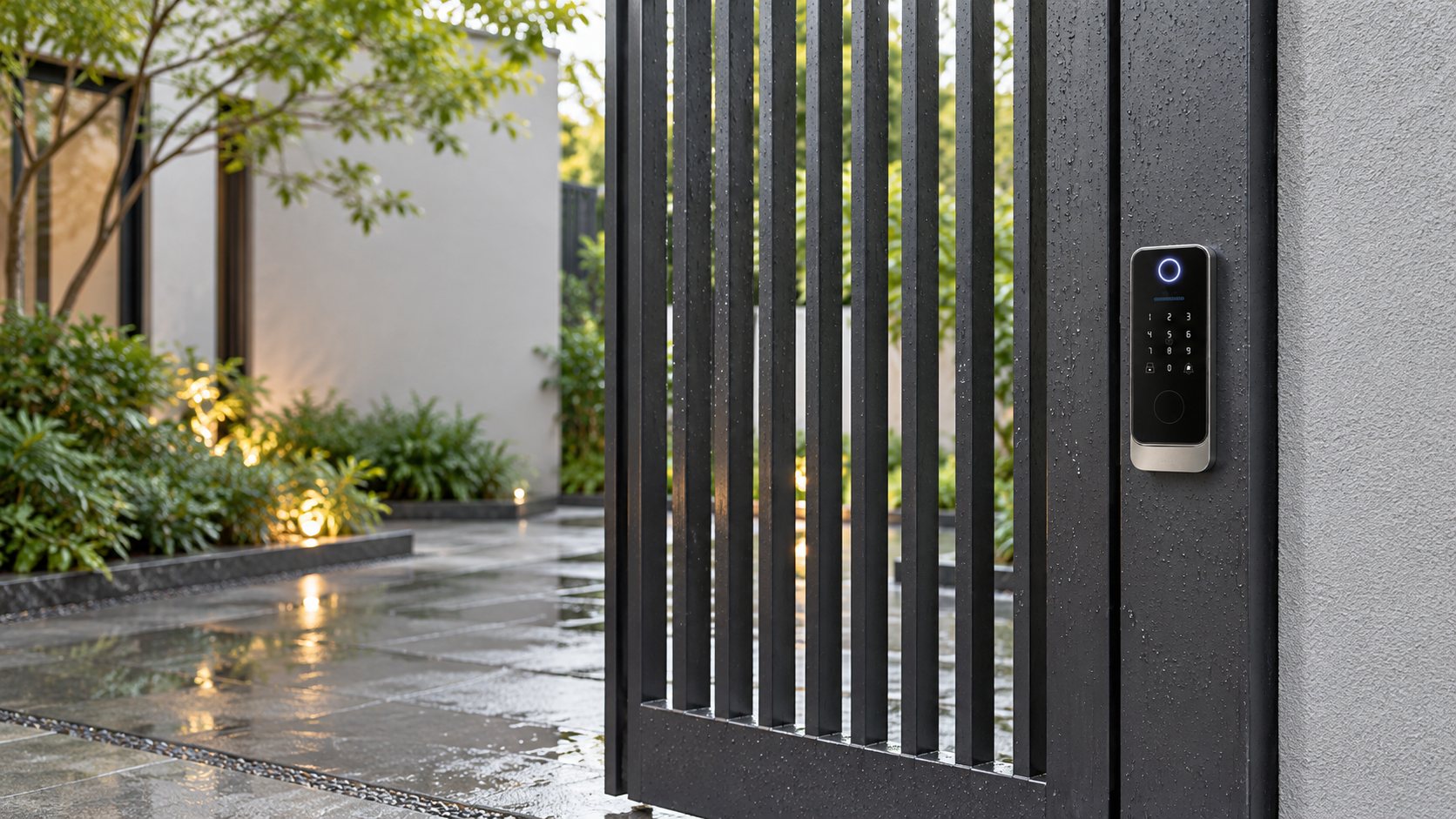
What IP55 and IP66 Mean
The IP code from IEC 60529 rates how well an enclosure keeps out dust (first digit) and water (second digit). Our models are rated IP55 or IP66:
| Rating | Dust | Water | Test in short |
|---|---|---|---|
| IP55 | Dust-protected: some dust may enter, not enough to interfere | Water jets from any direction | 6.3 mm nozzle, 12.5 L/min, at least 3 minutes |
| IP66 | Dust-tight | Powerful water jets from any direction | 12.5 mm nozzle, 100 L/min, at least 3 minutes |
An IP rating does not cover corrosion, sunlight on the finish, condensation inside a damp recess or wear on moving parts, and it applies to the lock as tested and fitted as instructed. All our IP66 models are also rated to work from −30°C to 70°C. The IP55 models are rated −25°C to 60°C, except R2, which is rated −30°C to 70°C in both versions. The waterproof smart locks page compares every IP66 model. For gates, see what IP ratings mean for outdoor gates; for damp recesses, materials for humid environments.
What Will the Lock Face?
Choose the condition that worries you most
Rain and Splash
Rain that reaches the lock directly, including wind-driven rain under a short canopy, splash from paving and runoff from a roof edge.
Sun and Heat
A gate or entrance facing the afternoon sun can get much hotter than the air around it, especially with a dark finish.
- Rating:IP66 models (and R2) work up to 70°C; the other IP55 models up to 60°C
- Finish:Approve the finish in daylight on site; see how it looks against the gate in full sun
- Check:Whether users will read a screen or face reader in direct sunlight at that spot
Cold and Frost
Below freezing, the lock itself is rated to −30°C (IP66 models and R2) or −25°C (the other IP55 models), but batteries can reach their limits sooner.
- AA and AAA:Standard alkaline cells are typically rated down to about −18°C; lithium AA cells are rated to −40°C (Energizer data sheets). Ask us before switching cell type
- Lithium packs:Recharge them indoors; lithium-ion cells should not be charged below 0°C
- Backup:The Type-C emergency port and the mechanical key are the backups; try both on the sample in cold weather, with the power bank you plan to use
Dust and Gate Movement
Gates collect dust and grit, and they sag, swing and get pushed, so the bolt does not always meet the strike the same way.
- Rating:IP66 is dust-tight; IP55 lets in some dust, not enough to interfere
- Fit:Check the gap to the post, the hinges and a firm stop, so the gate closes to the same place every time
- Format:A surface-mounted rim lock such as L1 suits gates without a mortise pocket
Salt Air
Salt is a corrosion question, not a waterproofing one, so it needs its own check.
- Material:SUS304 after a site assessment of salt exposure and cleaning
- Rating:IP66 if rain also reaches the lock
- Care:Wipe with a damp soft cloth and dry it regularly, including the strike and screw heads
Exposure Checklist
Send these with your inquiry, and we can match the model to the site:
- Photos of both sides of the door or gate, plus one side view showing any roof or canopy.
- Where water comes from: rain direction, roof edges, gutters, irrigation, paving that splashes.
- Sun: which way the lock faces, and whether it gets afternoon sun.
- Lowest and highest temperatures at the site in a normal year.
- Salt: distance to the sea, and how sheltered the lock is.
- The opening: door or gate thickness, the gap to the post or frame, and how it closes.
- Service: who changes batteries, and how easy it is to reach the inside of the lock.
Our exposed vs sheltered installation guide explains each point in more detail.
Temperature, Damp Heat and Service Life Tests
Climatic tests check that a lock keeps working at the limits of the weather it will meet. In a cold or dry heat test, the lock is held in a chamber at a set low or high temperature for a set time and checked during or after it. In a damp heat test it stays at a high temperature and humidity, which shows whether moisture affects the electronics, seals and finish. The IEC 60068-2 series is the common reference for these methods: part 2-1 for cold, part 2-2 for dry heat and part 2-78 for steady damp heat.
A service life test operates the lock again and again, for a set number of cycles, and checks that it still locks and unlocks correctly at the end.
We hold high and low temperature, damp heat and service life test reports. Each states its test conditions and the model tested; copies are available on request for the relevant models covered by the report. Salt air is a separate question; see corrosion resistance.
Power and Servicing Outdoors
Our outdoor models run on replaceable AA or AAA batteries or on a lithium battery recharged as a pack, depending on the model. Each has a 5 V Type-C port for temporary emergency power and a mechanical key as a second backup.
On a gate, check that the battery cover can be reached and opened once the lock is fitted, and that there is room to plug a power bank into the Type-C port. Write the battery type on the handover sheet, so maintenance staff use the right cells or charger. For projects with several models, keep AA, AAA and lithium spares separate. Temperature, daily use and connection activity all affect how long batteries last; see what affects smart lock battery life.
Approve It on the Real Gate
Samples are available for evaluation; we confirm the version, door fit and accessories before an order. Fit the sample on the actual gate or a representative door as our installation guide describes, then check that the bolt meets the strike every time it closes, that the battery cover and Type-C port can be reached, and how the finish looks in daylight. Keep a water test on site separate from the IP rating: the rating comes from a defined laboratory test.
Frequently Asked Questions
Are all your outdoor models IP66?
No. The rating depends on the model and version; R2, for example, is IP66 without the screen and IP55 with it. The waterproof smart locks page lists every IP66 model.
Is IP66 better than IP55 for every outdoor door?
IP66 adds dust-tightness and resistance to powerful water jets. An IP55 model intended for covered doors may suit a sheltered spot if the actual exposure matches; where rain or hosing reaches the lock, we recommend an IP66 model.
Will the lock work in freezing weather?
The IP66 models and R2 are rated down to −30°C, the other IP55 models to −25°C. In very cold climates, check the batteries too: standard alkaline cells are typically rated only to about −18°C.
Does IP66 mean the lock will not corrode?
No. IP66 is about water and dust getting into the housing. Corrosion depends on the material, finish, site and cleaning; see corrosion resistance.
What should I send for an outdoor project?
Photos of both sides, a side view of any shelter, the door or gate thickness, the lowest site temperature, distance to the sea and who will service the locks.
Send Your Site Details
Send photos of the gate or door, the exposure and the quantity. We will suggest the model, finish and power option for the site.