Outdoor Gate Smart Locks
An outdoor gate smart lock has to fit the gate, close the same way every time and keep working in rain and sun. The right one depends first on how the gate is built: a metal gate with no mortise pocket needs a surface-mounted rim lock, a gate with a pocket can take a mortise lock, and an aluminum courtyard door needs a narrow profile lock. Then come access from each side, weather and power.
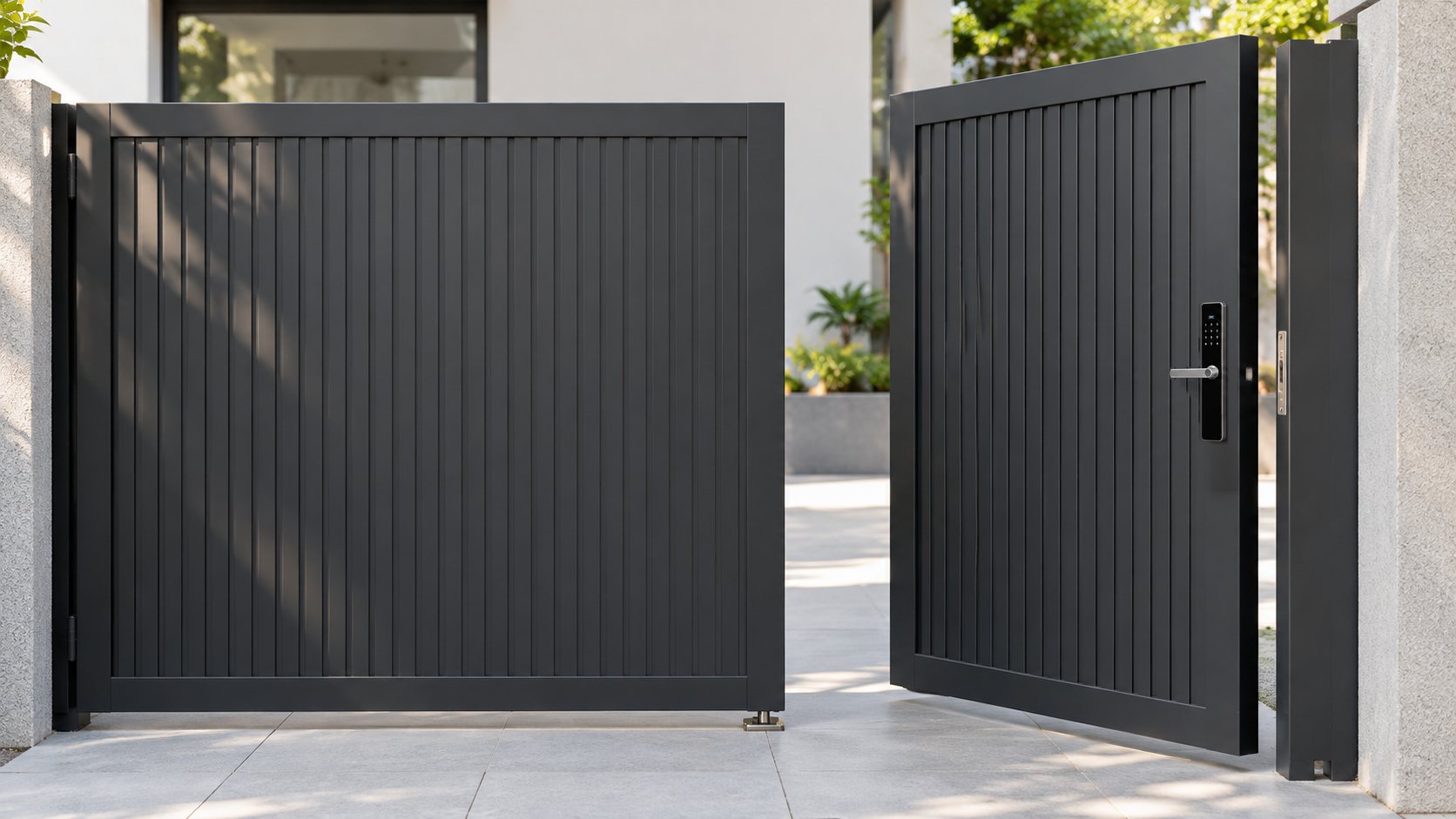
Which Lock Fits the Gate?
Start with how the gate is built: that decides the lock format. Access from both sides, face recognition and weather are extra requirements, covered below, that can combine with any of these.
How is the gate built?
Metal Gate, No Mortise Pocket
An existing iron or steel gate where nothing can be cut into the closing stile.
- Start with:L1, a surface-mounted rim lock, IP66, for gates 35–65 mm
- Check:Firm support for the 130 × 100 mm rear body, room for its 45 mm projection through the swing, and a post for the 35 mm strike
- Inside access:L2, the L1 version with a keypad built into the rear lock body, for PIN operation from the inside
Gate or Door With a Mortise Pocket
A solid gate, steel door or entrance door prepared for a lock body inside the leaf.
- Start with:A2, IP66, for doors 40–120 mm, with 6068, 4585 and Russian 6585 or 6085 mortises
- Check:The pocket, spindle and strike against the drawing, and that the panels cover the old holes on a replacement
- Versions:Local, Tuya or TTLock
Aluminum Courtyard Door
A narrow aluminum or thermal-break profile door or gate.
- Start with:A11, IP66, 290 × 40 mm panels, for doors 40–90 mm
- Check:Stile width, the space inside the profile for the mortise, and room for a hand beside the frame
- Power:1,000 mAh lithium or 4 × AAA version
Extra requirements
| If the gate also needs | Look at | Power |
|---|---|---|
| Fingerprint, PIN or card on both faces | A2 Double-Sided (40–120 mm) or A11 Double-Sided (40–90 mm), both IP66 | Lithium battery, recharged as a pack |
| PIN operation from the inside of a rim gate | L2, the L1 version with a keypad on the rear body | 4 × AA batteries |
| Face recognition outdoors | R2 screenless, IP66, 6068 mortise, for doors 50–120 mm; the screen version is IP55, recommended for covered doors | 7.4 V, 4,000 mAh lithium battery |
Check that the gate's construction suits the model first: the double-sided models and R2 need a mortise pocket, while L1 mounts on the surface.
Make the Gate Close the Same Way Every Time
A smart lock can only lock if the bolt meets the strike in the same place each time. Before choosing hardware, fix any sagging hinges, add a firm stop and check the gap between gate and post. On double gates, decide which leaf is active and how the other is held shut. With a rim lock, check that the rear body clears the post and any wall through the whole swing.
Our rim vs mortise guide compares the two formats in more detail.
Who Enters From Each Side
List who uses the gate from the outside (residents, visitors, delivery or service staff) and how people leave from the inside. Temporary codes from the app suit visitors and contractors; test how they are issued and how they expire before approving the version.
On an open-bar or mesh gate, check whether someone outside can reach through and operate the inside handle or release. If they can, plan a cover plate, a different handle position or a double-sided model with credentials on both faces. Remote access on TTLock versions needs a TTLock gateway and a Wi-Fi connection, so check the Wi-Fi signal at the gate. See the app and gateway guide.
Weather and Power
Start from the IP66 models when rain reaches the gate. All of them are rated −30°C to 70°C. Check both faces: the inside of a gate is often as exposed as the outside. Near the sea, also review the material, finish, strike and screws; see corrosion resistance.
Check that the battery cover and the 5 V Type-C emergency port can be reached once the lock is fitted, and keep the mechanical key as a second backup. In cold climates, check the batteries as well as the lock; outdoor durability explains why.
Trial and Batch Supply
Samples are available for evaluation; we confirm the version, door fit and accessories before an order. Fit the sample on the actual gate (the full checks are in our installation guide). With the gate open, check the fixing, the handle and the credentials; then close it and check that the bolt meets the strike every time, that the inside release works, and that the batteries and Type-C port can be reached.
For several gates, group them by format and size, approve one sample per group, and order spares by group. Record any site changes, such as a new stop or packing behind the strike, so later gates match.
Frequently Asked Questions
Which lock suits an existing iron gate?
Usually L1, a surface-mounted rim lock for gates 35–65 mm thick. Check the support for the rear body, the 45 mm projection and the strike position on the post.
Single-sided or double-sided?
Single-sided when people only need credentials outside. Double-sided (A2 or A11 Double-Sided) when they need fingerprint, PIN or card from inside too. If a PIN from the inside is enough, L2 is the L1 version with a keypad built into the rear lock body.
Can I use face recognition on an exposed gate?
We recommend the R2 screenless version, which is rated IP66. The R2 screen version and R1 are rated IP55, and we recommend them for covered doors.
Will the app work at the gate?
Bluetooth works near the lock. Remote access on TTLock versions needs a TTLock gateway and a Wi-Fi connection, so check the Wi-Fi signal at the gate before you choose.
Can we start before measuring everything?
Yes. Photos of both sides of the gate, a rough thickness and the quantity are enough to start.
Send Your Gate Details
Send photos of both sides of the gate, its thickness, how it opens, who uses it from each side and the quantity. We will suggest the format and model and prepare a sample.