Article contents 10 sections
No. A “SUS304 smart lock” has some SUS304 parts, usually the front and rear housings or the handle, and the label does not say which ones. On our range the SUS304 parts are the housings on most models; the lock body, electronics, seals, springs and screws are specified separately, and our quotations state the material per component.
A smart lock is an assembly. Its panels, handles, mounting hardware, lock mechanism, electronics and covers do different jobs and use different materials, so a declaration for one part says nothing about the others. A purchasing description that works moves from “304 stainless steel smart lock” to “front panel substrate: SUS304; brushed finish”: the part, its base material and its surface treatment, which both sides can then inspect against. For the full sourcing route from quotation to purchase order, see the 304 stainless steel smart lock sourcing guide for importers.
What the SUS304 Grade Tells You
SUS304 is a stainless-steel grade in the Japanese Industrial Standards system. The Japan Stainless Steel Association (JSSA) cross-references it with AISI 304, UNS S30400 and EN 1.4301, and notes that the comparison is approximate: the referenced standards, chemical limits, mechanical requirements and test methods can differ. [1] In an inquiry, “304” names the material family; in a specification where compliance with a particular standard matters, name the grade and the standard. A cross-reference table helps translate between them, but the requirement is the grade the order names.
The grade name does not answer several product questions:
| Wording in a quotation | What it tells you | What is still open |
|---|---|---|
| SUS304 smart lock | Some part of the product is SUS304 | Which components, in which configuration |
| SUS304 front panel | The front panel is the named part | Structural panel, decorative skin, or both |
| Stainless steel body | A part called the body is stainless | Which body, which grade, which subparts |
| Brushed stainless finish | A surface appearance | The substrate and its grade |
| Full stainless steel | A broad material description | The list of metal parts covered and the exceptions |
Even “SUS304 handle” needs a boundary: the visible lever alone, or also the spindle, retaining hardware and internal mechanism? A part description or drawing settles it.
A Material Claim Is Not a Complete Product Specification
A panel's grade says nothing about its thickness, dimensions, construction or fixing, so two quotations can name the same alloy for quite different parts. A stainless decorative cover over a separate supporting housing, for example, is a different construction from a panel in which the stainless part is itself the structural housing. On our SUS304 models the stainless parts are the housings themselves, which our Jinhua factory cuts, stamps, forms, welds and machines before polishing. To compare two constructions you need the drawing, a construction description and the performance requirements, not only the alloy.
Three questions run through the rest of this guide: which material is promised, where it is used, and whether the finished design suits the application.
Map the Components Before Discussing “All Stainless”
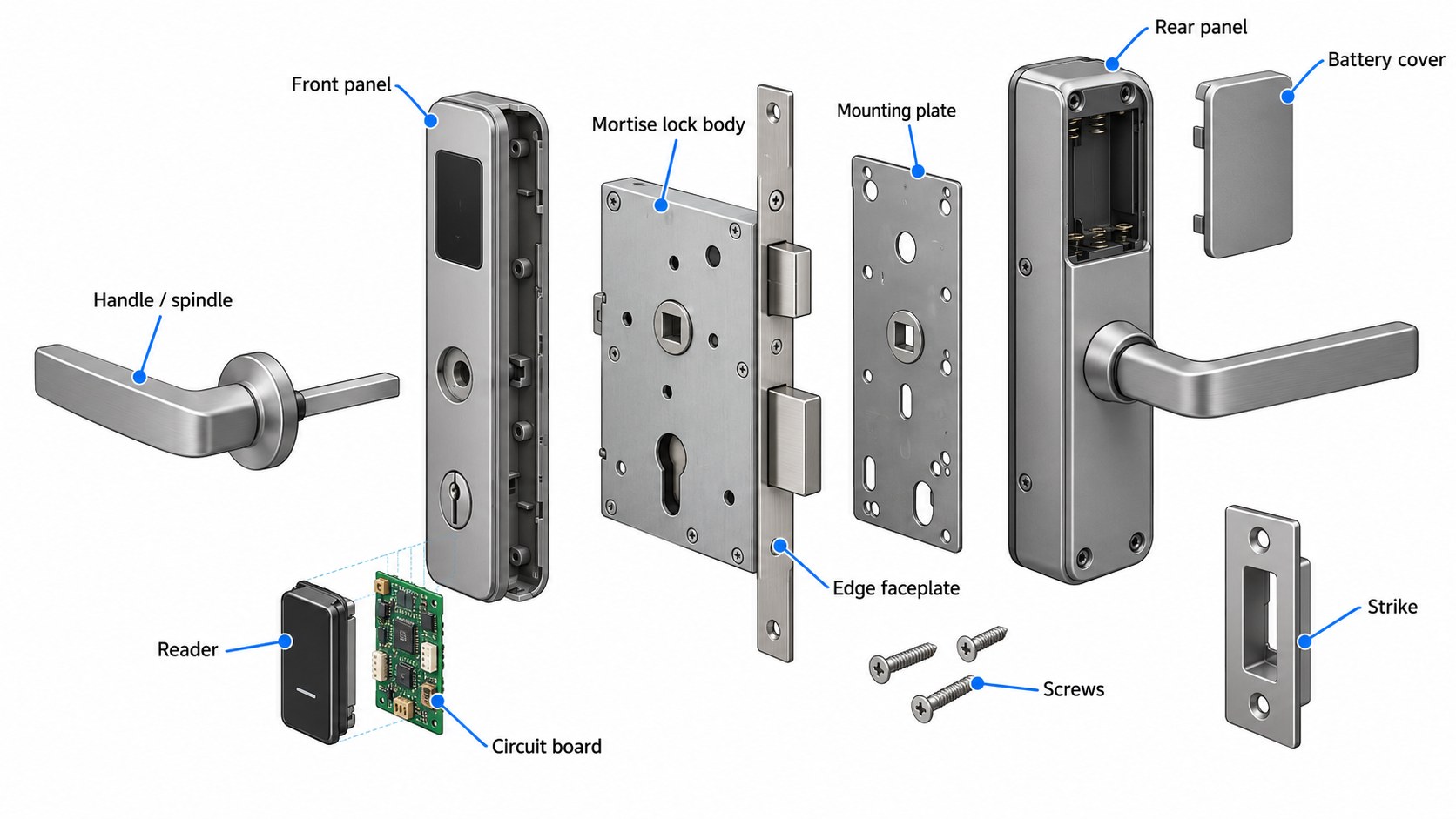
A short component schedule covering the parts in your specification defines the order; the full bill of materials (BOM) stays with the factory. Start from the parts you can identify in drawings or sample photos:
| Component | Boundary to make explicit | Why it matters |
|---|---|---|
| Front panel or escutcheon | Structural housing, decorative cover, or both | A stainless skin can sit on another housing material |
| Rear panel or escutcheon | Rear housing and any separate battery cover | The rear can differ from the front (our L1: SUS304 front, iron or stainless rear) |
| Handle or lever | Visible lever, spindle, internal mechanism | Several parts travel under one “handle” name |
| Mounting plate and internal brackets | Each supporting part | Hidden once installed |
| Mortise faceplate | The plate at the door edge | Separate from the panel and from the mortise case |
| Mortise case | The enclosure around the mechanism | Its latch, bolts, springs and gears are separate parts |
| Rim-lock body | Housing and named subparts | “Body” can mean this assembly instead of the front housing |
| Latch and locking bolts | Each part in the requirement | A faceplate declaration does not cover them |
| Screws and fasteners | Exposed and concealed | Panel material says nothing about fastener material |
| Strike or keeper | Frame hardware in the set | Often supplied or specified separately |
| Cylinder and key parts | Subparts of the cylinder | Rarely one uniform alloy |
| Covers, seals, electronics, motor, wiring | Function and any specified material | Chosen for function; a SUS304 claim does not cover them |
Use the factory's part names, with a marked photo or drawing where names are ambiguous. “Front” and “rear” get confusing on a double-sided lock; “outside escutcheon” and “inside escutcheon” tied to a drawing are clearer. With one schedule, the purchasing team, factory, inspector and installers all mean the same part; a short list with clear part names does this better than a long list of loose assembly names. The lock body in particular is chosen for the door; our mortises and lock bodies are listed per model and come in stainless steel versions, with iron or other materials for some functional parts.
Separate the Base Material From Its Finish
The substrate is the material under the surface; the finish is how that surface is processed or covered. They go in separate fields of the specification.
JSSA lists finishes such as No. 4 polishing, hairline, mirror and painted stainless steel separately from the grades. [2] Brushing and polishing process the surface itself; painting, plating and physical vapor deposition (PVD) add a layer on top. Neither kind of word identifies the alloy underneath. A black part can have a SUS304 substrate or a different one, and a silver metallic look tells you nothing about whether it is stainless.
Our range shows both cases. The A2 IP66 waterproof smart lock in Athens black is SUS304 under the finish; the Z1 smart lever lock is SUS304 in its stainless version and iron in black. Two colors of one model can therefore be two materials.
Compare these descriptions:
- “Front panel: SUS304 substrate, brushed finish.” Part, grade and finish are all named.
- “Front panel: black finish.” The appearance is named; the substrate is not.
- “Stainless steel appearance.” A look, with no alloy commitment.
Where the finish process matters to the purchase, the specification names it, because a color name can be reached by several processes and an approved color sample says nothing about coating thickness, adhesion or durability. Our polishing lines and the finishes applied by partners are described on smart lock surface finishing.
Keep Finish Variants Separate Until Their Materials Are Declared
A common comparison mistake is to assume every color of a model shares one substrate. A model number can cover several constructions, and a catalog can show several front-and-rear combinations side by side. Our L1 stainless steel rim smart lock is one: the front housing is SUS304 and the rear body comes in iron or stainless steel, so a photo of one version says nothing about the other, and “stainless rear body” still needs its grade stated if SUS304 is the requirement.
The purchasing record names the front panel, rear housing, finish and accessory set chosen. When a variant changes, the affected material entries are reviewed again before the revised offer is treated as equivalent.
Mixed Materials Can Be Appropriate; Unspecified Materials Need Clarification
A lock with some non-SUS304 parts can be exactly right. Each component's material follows its function and the requirements of the assembly, and the purchasing question is whether the declared construction meets your specification and site. One project requires SUS304 for the exterior panel and visible lever and sets functional criteria for the internal parts; another also names grades for the strike, faceplate and exposed fasteners. Both get called “stainless steel smart locks”, but they are different purchasing scopes.
Three kinds of answer mean different things:
| Answer | Meaning | Next step |
|---|---|---|
| “The front panel is SUS304.” | A grade is declared for a named part | Match the part and variant to the order |
| “The rear housing is painted carbon steel.” | Another material is declared | Compare it with the rear-housing requirement |
| “The rear housing is outside this declaration.” | The statement does not cover that part | Request its material if it affects acceptance |
The third answer is a gap in the declaration; it says nothing either way about whether the part is 304. Record it plainly, for example “rear-housing material not stated”, with the answer needed to close it.
Consider the Assembly Environment as Well as the Alloy
Mixed materials also make the joints worth a look. JSSA describes galvanic corrosion as something that can occur where different metals touch in an electrolyte, with severity set by the materials and conditions; two metals in one lock do not mean it will happen. [3] For an exposed installation, the questions are how water reaches joints, fasteners and contact surfaces, and how the design handles the site. That keeps the discussion on the real assembly instead of ranking locks by how much stainless they contain.
Turn a Broad Claim Into a Component Schedule
Take a quotation that says only “304 stainless steel smart lock”. The buyer needs the front and rear escutcheons and the visible lever in SUS304, and the mortise faceplate grade declared; internal hardware has its own functional requirements. The reply states that the front escutcheon and visible lever are SUS304 with a brushed finish, and says nothing about the rear escutcheon or faceplate. The schedule then looks like this:
| Component | Requirement in this example | Declaration so far | Status |
|---|---|---|---|
| Front escutcheon | SUS304; brushed | SUS304; brushed | Matches; sample check still to come |
| Visible lever | SUS304; brushed | SUS304; brushed | Matches; spindle and internal handle parts are separate entries |
| Rear escutcheon | SUS304; brushed | Not addressed | Rear-part declaration needed before approval |
| Mortise faceplate | Stainless grade to be declared | Not addressed | Grade needed, then compared with the requirement |
| Internal hardware | Functional requirements | Outside this declaration | Reviewed against those requirements |
The offer is not approved yet: two named items remain to close. When they arrive, update the rows and keep the original reply with the revised schedule.
What the Final Schedule Should Contain
For each part that matters to acceptance:
- Part identity: name, drawing reference and location on the lock.
- Requirement: substrate, grade, the material standard where one is required, and construction details.
- Finish: process, appearance reference and any finish requirements.
- Declaration: the exact material statement for that part.
- Configuration: model, front-and-rear combination, revision and options.
- Supporting record: quotation, drawing, declaration, certificate or report, with its date.
- Decision: what is accepted, and what is still open.
A single “confirmed” box for both a written promise and a physical test hides the difference. “Factory declared SUS304” records a commitment; “sample panel examined by the named method” records a test. Writing each down as what it is makes later inspection and any dispute far easier.
Carry the Material Scope Into the Order
The clarification is worth most when it survives into the purchase order. If the quotation names parts and grades and the order goes back to “SUS304 smart lock”, the precision is lost. The order can refer to the component schedule and drawing revision, and say how a proposed substitution or configuration change is handled; this matters most when a different rear body, finish, fastener set or lock mechanism is proposed after sample approval.
On repeat orders, compare the new configuration with the accepted schedule; a familiar model name can hide a changed part, so the order asks for any material change to a scheduled part to be reported against the approved revision. The same scope goes into the inspection instructions: when SUS304 is required for both escutcheons and the lever, “check stainless material” is too vague, and the instruction names those three parts and the evidence expected for each.
Distinguish a Material Promise From Physical Verification
Four records answer four different questions. A declaration states what the factory promises; a drawing states the specified material; a mill certificate reports on an identified batch of material; a physical analysis reports on the specimen examined. They support each other and none stands in for another. ASTM E1476 covers keeping metal identity through processing and choosing methods for grade verification and sorting [4]; for smart locks, that means tying each piece of evidence to a named part and configuration.
So a sheet certificate for an exterior panel needs a link from that sheet batch to the finished panel; a test report on a lever covers the lever; and a tested sample keeps its identity, with the production controls that connect it to the ordered units written down. Appearance and a magnet do not identify the grade, and handheld XRF identifies the alloy family but cannot measure carbon. Settling the component scope first lets the test provider choose the right method for each part; methods, test points and how to read the report are covered in how to verify a SUS304 smart lock sample. Our SUS304 material test report comes from an independent laboratory and names the sample it tested.
A SUS304 Claim Does Not Establish Outdoor Performance
Stainless steel resists corrosion through a passive surface film, and that film has limits. JSSA describes localized corrosion such as pitting and crevice corrosion in susceptible conditions, including chloride environments. [3] Salt deposits, chloride cleaners and dirt that holds moisture on the surface can stain SUS304, and under aggressive chloride exposure it can pit locally.
A correctly declared SUS304 panel therefore says nothing about the lock's water resistance, coastal suitability, service life or mechanical security; those depend on the whole design and its evidence: seals, joints, surface condition, installation and exposure. Our IP ratings are given per model, separately from the housing grade. The material review asks whether the promised parts use the specified materials; the application review asks whether the finished lock suits the site; a precise material schedule feeds both. For the site side, see choosing smart locks for coastal environments and smart lock materials for humid environments.
Frequently Asked Questions
Does “full stainless steel” mean every metal part is SUS304?
No. The phrase names neither the parts nor the grade. A list of the included components, the grade of each required part and the exceptions turns it into something you can check; even a claim covering every metal part needs the grade stated when SUS304 is the requirement.
Can the front panel be SUS304 while the rear housing uses another material?
Yes. Our L1 rim lock has a SUS304 front housing and a rear body in iron or stainless steel. Whether a combination is acceptable is set by your requirement, so front and rear are recorded separately and the version ordered is named.
Does a SUS304 declaration establish 304L?
No. SUS304 and SUS304L are separate grade designations; JSSA explains that the L suffix means low carbon. [5] When a low-carbon grade is required, specify it and use evidence that measures carbon.
Can a magnet tell whether a lock is SUS304?
No. SUS304 is largely non-magnetic, but forming and bending change part of its structure and can make a finished housing slightly magnetic. Alloy analysis of the part is the check.
References
- Japan Stainless Steel Association. Comparison with Foreign Standards. Japanese-language grade comparison with qualifications on interchangeability.
- Japan Stainless Steel Association. Main Stainless Steel Surface Finishes. Japanese-language description of finish types and processes.
- Japan Stainless Steel Association. Stainless Steel Corrosion Resistance and Corrosion Phenomena. Japanese-language guidance on passive films, localized corrosion, and galvanic corrosion.
- ASTM International. ASTM E1476-04(2022): Standard Guide for Metals Identification, Grade Verification, and Sorting. Public scope and significance-and-use sections.
- Japan Stainless Steel Association. Meaning of JIS Steel Designations and Grade Suffixes. Japanese-language explanation including the low-carbon L suffix.