Article contents 10 sections
To choose an outdoor gate smart lock, start with the gate and leave the catalog for later: its profile and movement, the weather that reaches each face, and who has to get through from each side. Those three things decide between a rim and a mortise lock, single- or double-sided access, and the power and recovery arrangement. Features, finish and price come after.
A lock that looks right in a photo still fails if the frame is too narrow, the leaf sags so the strike drifts out of line, the inside half sits in the rain, or nobody can get in when the battery or the network is down. Below are those points in the order we check them on a gate project, ending with a sample fitted to the real gate.
1. Start With the Gate Conditions That Decide the Lock
An outdoor gate is a less stable mounting surface than a building door. Frames are often narrow steel or aluminum profiles, one gate is rarely fabricated exactly like the next, hinges sag, and wind or slamming shifts the latch line. The same lock can behave very differently on two gates that look alike from a distance.
Photograph the gate closed, the lock edge, the strike side and the opening direction, and measure the profile and the mounting area. These are the inputs that decide the lock:
| Gate input | What to record | Why it matters |
|---|---|---|
| Gate material and profile | Steel, aluminum, wood, tubular frame, solid section, narrow profile | Determines mounting options and fabrication risk |
| Available mounting area | Width, depth, flat surface, obstructions | Determines whether the front/rear assemblies can sit correctly |
| Gate movement | Sag, flex, rebound, wind movement, hinge play | Affects latch and strike alignment |
| Opening direction | Inward/outward and left/right configuration | Affects handing, handle travel and installation layout |
| Existing hardware | Current cutout, latch, rim case, mortise, strike | Determines retrofit versus new fabrication |
| Service access | Can the lock body, batteries, fasteners and cables be reached later? | Affects maintenance and field replacement |
Thickness, backset, center distance, cutout, lock-body size, strike position and handing are then checked against the model drawing by the installer or gate fabricator.
If the leaf has to be lifted or pushed before the current latch engages, fix the gate first. Sag stays after the new lock goes on, and a misaligned gate makes any lock look faulty in a trial.
2. Screen the Exposure Before You Choose the Hardware
“Outdoor” covers very different conditions. A lock under a deep roof at a villa entrance lives a different life from a perimeter gate in wind-driven rain, irrigation spray, afternoon sun or coastal salt. The two faces of one gate often differ too: one sheltered, the other in direct rain and sun.
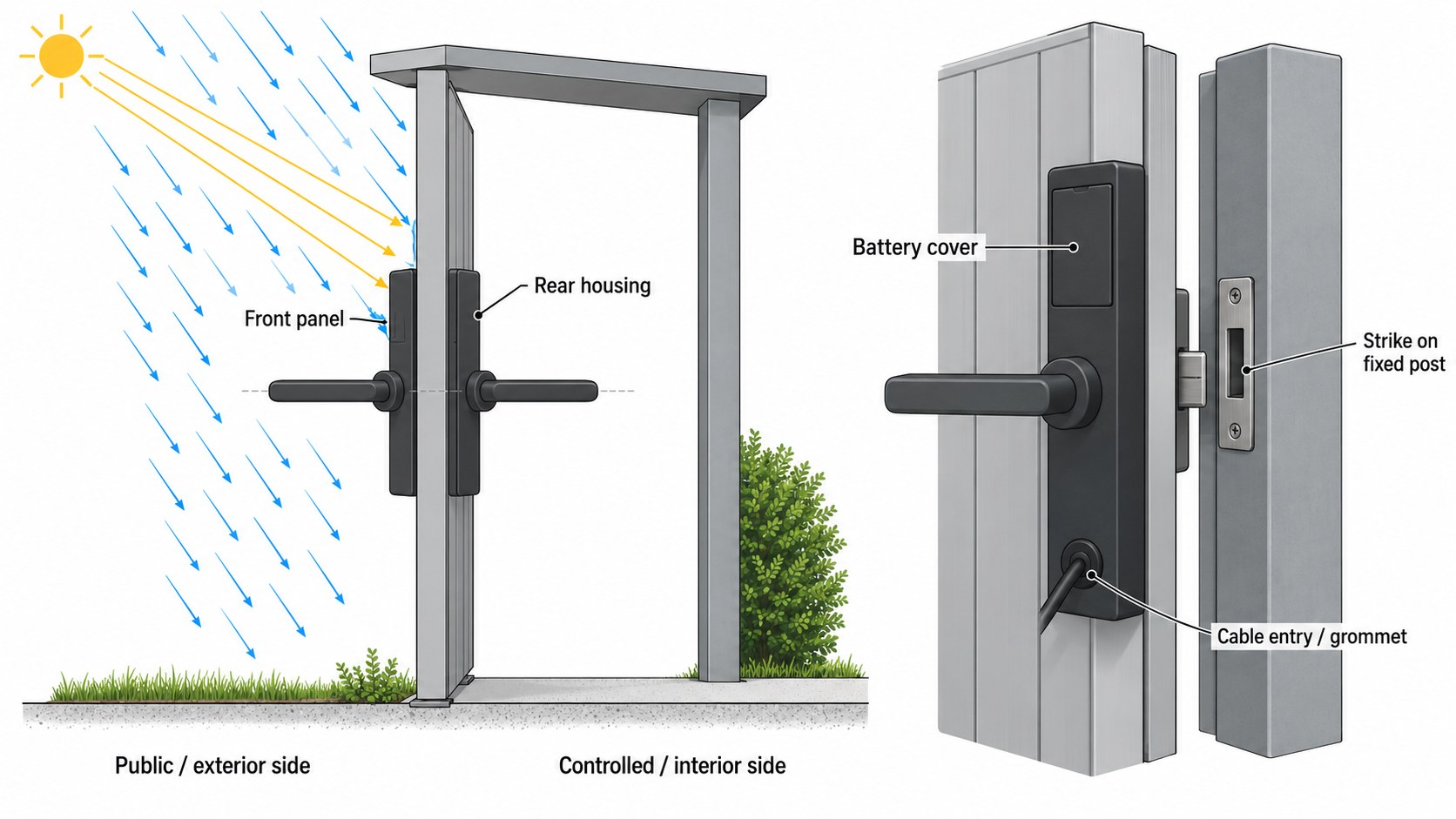
Classify the installation by what reaches the hardware:
- direct rain or only occasional splash;
- sheltered, semi-sheltered or fully exposed placement;
- direct sun and high surface temperature;
- dust, sand or roadside contamination;
- persistent humidity or condensation;
- coastal or salt-air exposure;
- irrigation, washdown or water that can collect around the lock or cable entry.
Each condition affects a different part of the lock. Water ingress, corrosion and UV each have their own test, and a material name answers none of them for the whole installed assembly.
Exposure changes the shortlist, not just the finish
A sheltered gate accepts a wider range of hardware. A fully exposed gate puts the whole assembly in the weather: rear housing, battery compartment, openings, cable entries, fasteners and any holes the installer drills.
The IP Code in IEC 60529 classifies how well an enclosure keeps out solids and water.[1] IP66 means the tested enclosure is dust-tight and protected against powerful water jets. It says nothing about corrosion, UV or condensation, or about the strike, cables and holes the installer drills; those are checked separately.
Salt-spray results come from a controlled laboratory atmosphere, and the public scope of ISO 9227:2022 says its methods are not intended to predict long-term corrosion resistance.[2] Salt-spray hours compare finishes when you know the part, the method and the acceptance criteria; they do not convert into years at the gate.
With stainless steel versus zinc alloy, the question is which parts are made of each and how the exposed surfaces are finished. On most of our models the SUS304 parts are the front and rear housings; the L1 rear body comes in iron or stainless steel, so the quotation names which one an exposed gate gets.
Each exposure has its own guide: exposed vs sheltered installations, smart locks for coastal environments, smart lock materials for humid environments and how to read salt spray test hours.
3. Choose the Lock Architecture the Gate Can Support
The main architecture decision on a gate is rim (surface-mounted) or mortise. The right one is the one the gate can carry without heavy fabrication, fragile alignment or awkward service later.
| Decision factor | Rim / surface-mounted route | Mortise-based route |
|---|---|---|
| Internal profile depth | Less dependent on a deep internal cavity | Requires enough usable depth for the lock body and interfaces |
| Gate fabrication | Can reduce dependence on a large internal cutout | Requires accurate preparation and repeatable geometry |
| Retrofit work | Often easier when the existing gate has no room for a conventional mortise | Better suited to a prepared profile or new fabrication |
| Serviceability | Surface components are usually easier to reach | Service can be harder if the lock body is enclosed tightly |
| Alignment | Strike position and latch engagement must remain correct as the gate moves | Cutout, lock body and strike must align within the model’s specified tolerances |
| Appearance/integration | More visible hardware | Can provide a more integrated appearance when properly designed |
Choose rim when the profile is narrow, the internal depth is limited, or you need a simple retrofit. Exposure, fastening and the strike still have to suit the site.
Choose mortise when the gate has the profile depth, accurate fabrication, stable alignment and room to service the lock body. "Mortise" then has to become a named lock body that fits the cutout.
Pick the mounting system that matches the gate first, then the model.
4. Check Physical Compatibility Before Sampling
Gate projects usually fail on details missing from a catalog photo: the rear housing hits the frame, the handle hits a picket, the latch falls short of the strike, the lock body is deeper than the profile, or a cable runs where it flexes and gets wet.
Before sampling, check:
- gate/profile thickness and usable depth;
- front and rear mounting area;
- opening direction and handing;
- lock-body or rim-case dimensions;
- latch/bolt travel and strike position;
- handle and spindle clearances;
- existing holes or cutouts;
- cable path, if wiring is required;
- battery/service access;
- room to reach the mechanical key and the emergency power port.
A thickness range screens a model; the whole geometry decides the fit. For an existing gate, annotated photos or a drawing tell us far more than “standard metal gate”, especially on an unusual frame.
5. Decide Which Side Needs Access, Then Define Power and Recovery
Decide how people use each side before you decide the hardware: which face is public, which is controlled, who uses the gate, and how they get out.
Single-sided versus double-sided access
Single-sided access suits a gate with one normal entry side and a simple release on the other. Double-sided access suits a gate where both directions need a credential. Let the traffic decide: if the inside user just needs to walk out, a second reader adds cost and adds nothing to security.
Settle these questions:
- Who normally approaches from each side?
- Does the inside user need a credential for routine exit?
- Is the gate shared by staff, residents, contractors or visitors?
- Is there a separate life-safety, pool, accessibility or emergency-release requirement that needs specialist review?
- What happens when a credential reader, battery or connected service is unavailable?
Power is part of the access design
Gate locks run on batteries or wired power, usually with a backup. Our A2 runs on 4 AA batteries, the double-sided A2 and A11 on a lithium pack, and every one of our smart locks has a mechanical key and a 5 V Type-C port that a power bank can use to wake a flat lock. Record for the model you choose:
| Power/recovery question | Project answer needed |
|---|---|
| Normal power source | Battery, wired supply, or other named configuration |
| Low-power warning | What indication is available and who responds? |
| Emergency power | Where the emergency input sits, and which face it is on |
| Mechanical/local fallback | What approved local method remains available? |
| Network loss | Which local access methods still function? |
| Service ownership | Who holds keys, spare batteries or recovery instructions? |
Local unlocking and remote management fail differently. On our locks, fingerprints, PINs and cards already enrolled keep working within their validity when the network is down; remote changes and log sync need the connection, and on a TTLock version that means the TTLock gateway and Wi-Fi. Power loss is the other case: the key and the Type-C port cover it, so check that staff can reach the face that carries them.
The question that matters: with normal power or connectivity gone, can the site still use the gate the way it needs to?
The access-side choice is covered in more detail in single-sided vs double-sided smart locks for gates.
6. Pin the Quote to One Configuration
Once the gate, exposure, architecture, access sides and recovery are clear, the quotation should name one configuration. “A waterproof fingerprint lock for an iron gate” answered with a model photo answers none of these questions. The quotation should state:
| Item | What it names |
|---|---|
| Product identity | Exact model and variant |
| Gate fit | Supported thickness and profile, with the model drawing |
| Architecture | Rim case or the named mortise lock body |
| Outdoor rating | IP rating and the parts it covers |
| Material and finish | For the quoted version, as well as the product family |
| Power | Battery or supply arrangement |
| Recovery | Mechanical or emergency access for that configuration |
| Access sides | Which side reads a credential and how the other side opens |
| Documentation | Installation drawing and manual |
| Market | Target country and any project-specific compliance review |
A drawing or recovery instruction still to come stays an open item on the list until it arrives. What the IP line on that quotation covers is explained in what IP ratings mean for outdoor gate smart locks.
7. Turn Candidate Models Into a Shortlist
Compare each candidate against the gate's requirements before comparing candidates with each other. The better candidate is the one that leaves the fewest open assumptions, often a simpler model than the one with the most features.
| Decision area | Candidate must show | Stop / hold condition |
|---|---|---|
| Gate fit | Drawing or dimensions that match the actual profile and installation method | Fit depends on unverified cutting, spacers or field improvisation |
| Exposure | IP rating and material of this model suit the location | Outdoor claim applies only to another variant or only one side of the assembly |
| Architecture | Rim or mortise route matches the gate structure and service access | Gate would need excessive modification or leaves poor service access |
| Access sides | Required entry/exit behavior is clear on both sides | One side’s normal or emergency operation is still undefined |
| Power/recovery | Normal power, low-power behavior and local recovery are understood | Project can be locked out by a foreseeable power/network condition |
| Documentation | Model and configuration named, with drawing, manual and test reports | Quotation names only a product family |
| Project fit | Target market and any specialist review are identified | Compliance, egress or project review has no named owner |
Use the matrix as a go / hold gate, not a score. A candidate with the best finish, app and price stays on hold if the rear housing sits in the rain and the rating covers only the front panel. A model with the right IP rating stays on hold if its mortise needs untested fabrication to fit the profile. The same questions also make two quotations comparable when they use different terms.
A model can be worth sampling before it is ready for release. Keep the open items visible on the shortlist, such as a pending drawing, the emergency-power method, a coastal finish or the access-side decision, so that a good price does not turn into a technical approval by default.
Hold any candidate while one of these is true:
- the gate sags or latches inconsistently;
- the profile or cutout dimensions are unknown;
- an indoor-only assembly would face direct weather;
- the IP or material claim belongs to a different model or version;
- the access-side requirement is unclear;
- there is no workable local recovery path;
- a life-safety or local-code requirement has no named reviewer.
Any one of these can change the right lock architecture.
8. Check a Sample in the Intended Installation
A bench demo shows that a credential opens the lock. A sample on the real gate also shows handle collisions, strike misalignment, battery covers you cannot reach and a recovery port on the wrong side. We agree a short trial with the installer before the configuration is approved:
| Trial | What to observe | What should trigger a correction |
|---|---|---|
| Fit and fastening | Both housings sit as specified; fasteners and the strike have sound support | Distorted covers, unsupported screws, or unapproved spacers |
| Closing and engagement | The gate closes and latches without being lifted or pushed sideways | Binding, partial engagement, or a lock indication that disagrees with physical engagement |
| Use from both sides | Authorized entry and the required exit method work in the installed position | Controls are obstructed, hard to reach, or operate differently from the agreed access plan |
| Network interruption | Agreed local credentials work with the connection unavailable | Routine access unexpectedly depends on a gateway or cloud service |
| Power recovery | The documented recovery method is reachable and usable | Emergency power, keys, or service access are available only on the inaccessible side |
| Routine service | Batteries or service parts can be reached and covers refitted as instructed | Service requires removing unrelated gate hardware or leaves a cover incorrectly seated |
Run the power and network checks with another way through the gate available, and follow the manual's procedure. A short trial covers fit and operation; corrosion and ingress are covered by their own tests.
Egress, accessibility, pool-gate and local-code requirements go to the responsible local reviewer before approval. Record the accepted model, finish, lock body, power arrangement, drawing and accessories, so that production matches the approved sample.
9. What We Need to Recommend a Gate Lock
For a SivoLock gate project, photos of both faces, the profile thickness, the opening direction, who uses each side and the quantity are enough for us to suggest the format and model, confirm the version and accessories, and prepare a sample. Our rim gate smart locks and waterproof smart locks pages compare the models. For a project with many gates or doors, see the project specification and RFQ guide.
References
- International Electrotechnical Commission, IEC 60529 — Degrees of protection provided by enclosures (IP Code). https://webstore.iec.ch/en/publication/2452
- Estonian Centre for Standardisation and Accreditation (EVS), ISO 9227:2022 — Corrosion tests in artificial atmospheres — Salt spray tests, public catalog scope. https://www.evs.ee/en/iso-9227-2022