Article contents 10 sections
An IP rating tells you how well a lock's enclosure keeps out dust and water under defined test conditions. For an exposed outdoor gate, start from an IP66 model; for a sheltered position IP55 or IP65 can be enough, depending on the installation and on how exposed each side is. IP67 and IP68 describe immersion, which is a different condition again. The rating is evidence about the enclosure, and three questions turn it into a purchasing answer: What object was tested? What do the two numerals describe? Does that tested configuration match the lock and installation you are buying?
IEC 60529 classifies degrees of protection provided by enclosures for electrical equipment.[1] Intertek's public IEC 60529 overview describes the same enclosure-centered structure and lists the common solid and water test categories.[2] Choosing the lock format for the gate is covered in the outdoor gate smart lock selection guide.
1. Read the Two Numerals Separately
The first characteristic numeral covers protection of people against access to hazardous parts and protection of the equipment against solid foreign objects, with dust protection at the higher levels.[2][4] “Hazardous parts” means parts inside the enclosure; the digit has nothing to do with burglary resistance. A first numeral of 5 means dust-protected (some dust may enter, not enough to interfere) and 6 means dust-tight under the relevant conditions.[2] Neither level says anything about corrosion, impact strength, condensation or service life.
The second characteristic numeral covers protection against harmful effects of water entering under the relevant test conditions.[4] It describes the tested enclosure, not the installed gate with its openings and service ports. And because the test judges harmful effects, a pass does not mean no water ever gets in.
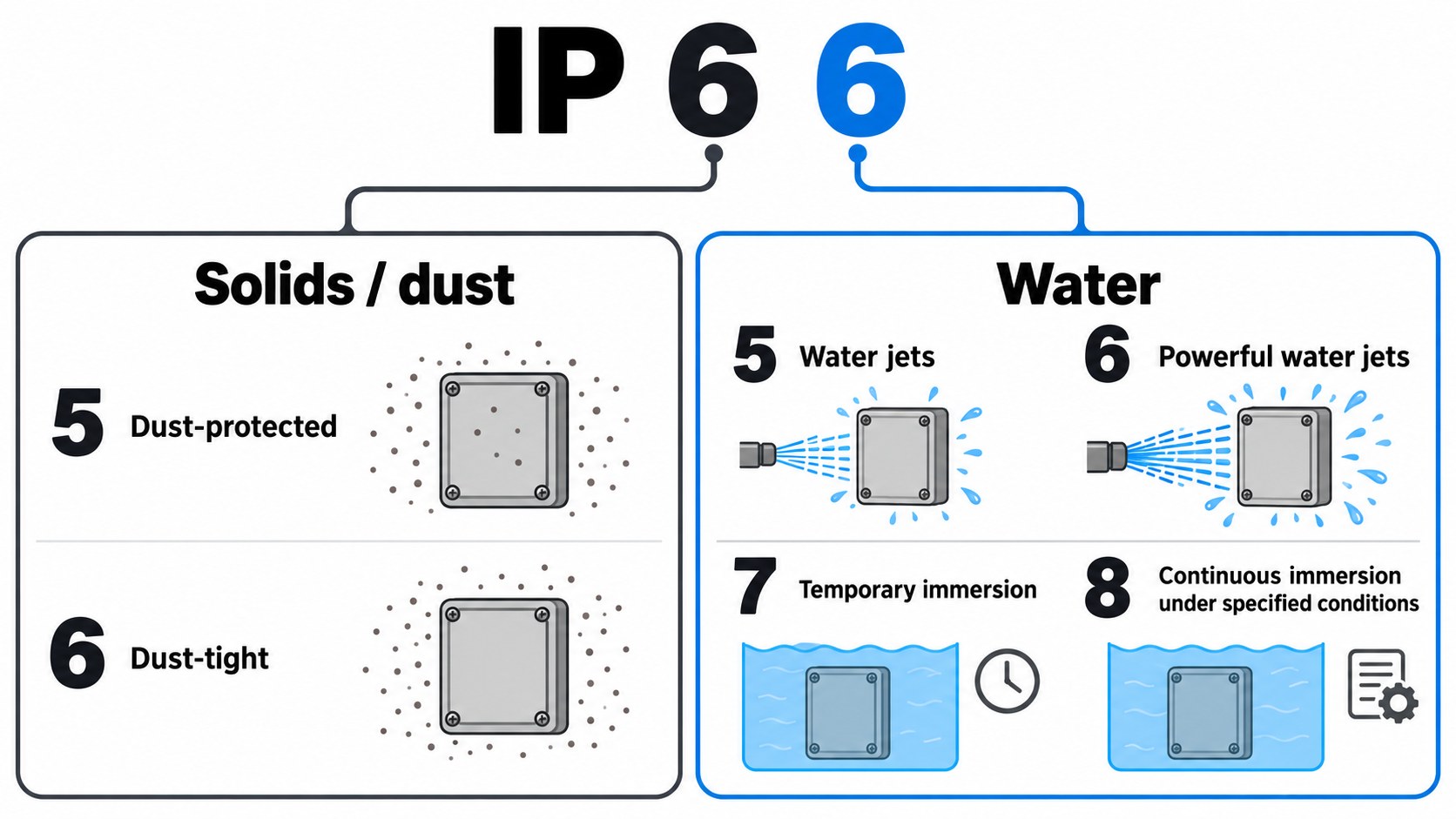
An IP code answers two ingress questions and nothing more. It is not a general quality score, and a higher digit is only one input to whether a lock suits an outdoor gate.
2. Water Digits: Jets and Immersion Are Different Conditions
Intertek's summary gives x5 as water jets, x6 as powerful water jets, x7 as temporary immersion and x8 as continuous immersion.[2] The report itself states the tested object and conditions. In the test, x5 is a 6.3 mm nozzle at 12.5 liters a minute and x6 a 12.5 mm nozzle at 100 liters a minute, sprayed from all practicable directions, after which the inside is checked for water; for the dust-tight 6, the enclosure sits in a chamber of circulating fine talcum powder and no dust may enter. That is how the test runs under IEC 60529, and we hold an IEC 60529 test report for the models it covers (waterproof smart locks).
| Example code | What it means | What it does not cover |
|---|---|---|
| IP55 | Dust-protected (limited dust allowed), x5 water jets | Dust-tightness; powerful x6 jets |
| IP65 | Dust-tight, x5 water jets | Powerful x6 jets; immersion |
| IP66 | Dust-tight, stronger x6 water jets | Immersion |
| IP67 | Dust-tight, x7 temporary immersion | Water jets, unless also marked x5 or x6; staying underwater indefinitely |
| IP68 | Dust-tight, x8 continuous immersion under stated conditions | Water jets, unless also marked x5 or x6; depths or times beyond those stated |
IP67 or IP68 alone does not cover water jets. NEMA's public explanation of IEC 60529 states that enclosures marked only with a second numeral of 7 or 8 need not meet the requirements for 5 or 6 unless they are dual-coded.[4] Where a gate needs both, look for a dual marking such as IP66/IP68, with the tested object and conditions stated for each.
For IP68, read the stated immersion depth and duration; “continuous immersion” holds only under those conditions. In the same way, IP66 covers the test nozzle and flow, not a particular pressure washer, nozzle distance or cleaning chemical.
An “X” means that numeral was not rated. It is a placeholder, not zero or “no protection”: F2 Labs explains that X takes the place of the digit when there is no rating for that criterion.[5] IP6X, for example, states the dust level and says nothing about water; an X does not stand for any minimum.
3. The Tested Object Matters More Than the Headline
An IP claim can apply to one exterior panel, a front enclosure, a rear enclosure, a complete assembled lock, or a particular variant with its covers fitted. A screen version, double-sided version, accessory plate or field-modified lock can be a different object. Our R2 shows it within one model: the screenless version is IP66 and the version with a screen is IP55.
The lock maker should be able to name:
- the exact model and variant;
- the tested enclosure or assembly;
- orientation and configuration;
- the report or declaration and its stated limitations;
- front and rear scope;
- the covers, keyholes, battery compartments, emergency ports, gaskets and accessories included;
- cable entries and mounting holes in the tested arrangement;
- any change that needs their confirmation.
These points let you compare documents. A certificate that summarizes a rating can still need the report behind it, or the installation instructions, for the details that matter on the gate.
UL Solutions treats Type/IP-rated enclosures and enclosure accessories separately, including latches, hole plugs, window kits and cable-sealing devices.[3] The same distinction applies to a lock: the rating belongs to the assembled configuration, and a separately rated component sets the rating of the complete product only when the assembly was tested with it.
A battery cover tested closed is rated closed, not open. A new cable hole, a substitute gasket or a different mounting plate changes the arrangement, and only the lock maker can say whether the claim still holds. On our locks the sealing is built in during assembly, before the housing is closed: sealant over the circuit-board cover and round the motor module inside the panel, and on the L1 keypad a circuit board potted in compound inside its stainless steel housing. On site, the panel gasket stays seated and unused holes in the door are sealed.
Read the document type before relying on it
A manufacturer declaration records the maker's claim, so check the product identity and the basis for it. A test report describes the specimen, method, conditions and results within its scope. A certificate can summarize a test result or belong to a certification scheme; its scope and issuer say what was evaluated, whatever its title.
When a certificate leaves the assembly or interface conditions unclear, the underlying report reference answers it. Where a certification scheme is claimed, check the listing with the issuing organization and which products and ratings it includes; UL's enclosure page separates its testing from its Listing and Recognition certification services.[3]
A planned ingress test has no result yet. A tested specimen shows that the design passed; it does not mean every delivered unit was tested, or that a certification scheme keeps checking production. Record planned tests, completed tests and certification claims as three different things.
4. What IP Does Not Prove
The IP code covers dust and water getting into the tested enclosure. Corrosion and coastal suitability, salt-spray performance, humidity and condensation, UV and temperature range, battery and electronics life, mechanical endurance, vandal resistance, cybersecurity, fire and egress compliance, maintenance intervals and total outdoor service life all need their own evidence. So do the questions closer to the gate: whether a front-panel claim includes the rear, whether a port is protected while open for service, and whether the complete gate installation is approved.
When a gate faces salt air, condensation, unusual heat or frequent washdown, ask for evidence on that risk as well. For our locks, temperature is stated per model: the IP66 models are rated −30°C to 70°C, the IP55 models −25°C to 60°C, except the R2 screen version, which is rated −30°C to 70°C. We also hold salt spray test reports to ISO 9227 and high and low temperature, damp heat and service life test reports, each for the models it names (outdoor durability).
5. IP Must Match Installation Position
The site can add direct rain, wind-driven rain, splash, roof runoff, retained water, and different exposure on the front and rear. A mounting plate, field-drilled cable hole, substituted gasket or changed orientation can also alter the tested arrangement.
Compare the tested configuration with your gate drawing and send each difference to the lock maker to confirm. A canopy or recess cuts rain, but how much depends on its depth and on drainage; that review uses the installation drawing and site photos, and is covered in exposed vs sheltered outdoor installations.
6. Build an Evidence Request
| Evidence field | What to request |
|---|---|
| Model / variant / accessories | The claim matched to the quoted configuration |
| Complete IP marking | Both numerals, and any X or optional letters |
| Tested object | Front, rear, enclosure or complete assembly |
| Test basis | Standard and edition, report or declaration, result, limitations |
| Orientation / installation | Test arrangement against the proposed gate |
| Covers and interfaces | State of battery cover, keyhole, emergency or Type-C port, gaskets |
| Penetrations and accessories | Whether cable entries, holes, plates and plugs were included |
| Front/rear scope | Whether both assemblies are covered |
| Separate durability evidence | Corrosion, coastal, humidity, UV, temperature, service life as relevant |
Grade the evidence you actually hold:
| Level | Evidence available | Use |
|---|---|---|
| A | Formal report or certificate tied to the exact model, object and conditions | Firm basis for comparison |
| B | Exact-model declaration without the report | Provisional; follow up on scope |
| C | Product or category claim with an unclear object | Shortlisting only |
| D | “Waterproof”, “weatherproof” or “outdoor” wording | Marketing signal only |
Reading the report itself, line by line, is covered in how to read an IP test report.
7. When the Higher IP Number Is Not the Answer
Take two gates on one site. A courtyard entrance under a deep canopy is offered the R1 3D face recognition smart lock, rated IP55; a freestanding side gate is offered the A2 IP66 waterproof smart lock. The numbers are where the comparison starts. For R1 the question is whether the canopy really keeps rain, splash and runoff off the lock, since we recommend our IP55 models for covered doors. For A2 on the freestanding gate the questions are the rear face, the interfaces and the mounting arrangement; both faces of a gate can take rain, so A2's rear unit and cable route need placing out of the runoff as carefully as the front.
A second case: a double-sided lock is listed as IP66, and the documents turn out to cover the front enclosure only. The front claim is recorded with that scope, and the rear-assembly evidence, including its battery cover and emergency port, is requested. The scope comes from the evidence, whatever the product-page heading says.
A report-to-quotation check
Suppose a report covers one variant's front enclosure, installed upright, with its power-port cap closed and the original gasket fitted, while the quotation offers another variant with a different rear battery housing and an installer-added cable entry.
| Comparison | What the documents establish | Before relying on the claim |
|---|---|---|
| Model and variant | Report names one variant; quotation another | Evidence or a documented technical explanation for the quoted variant |
| Enclosure scope | Front enclosure only | Evidence for the exposed rear housing |
| Power port | Cap closed in the report | The permitted conditions for opening or using the port |
| Mounting interface | Original gasket, no added entry | Confirmation for the proposed cable entry and mounting detail |
The report supports the claim for the tested specimen, but it does not cover what was quoted. The quoted variant may well perform; the documents just do not show it. The lock maker closes the gaps with evidence that applies, or offers a configuration its documents already cover.
8. Practical Decision Sequence
- Record the complete IP marking, including any X or optional letters.
- Identify the exact model, variant, tested object and test conditions.
- Check front and rear, covers, ports, penetrations, accessories and orientation.
- Compare that scope with the real gate drawing and exposure.
- Request separate corrosion, humidity, temperature, UV, fit and recovery evidence where relevant.
- Approve only when every scope field is answered.
Frequently Asked Questions
Does IP66 mean a smart lock is waterproof?
IP66 means the tested enclosure is dust-tight and protected against powerful water jets. Immersion is tested separately under x7 or x8, so IP66 is a jet rating, not a general “waterproof” claim.
Is IP68 always better than IP66 for an outdoor gate?
No. Jets and immersion are different conditions, and IP67 or IP68 includes the x5/x6 jet tests only when the marking and evidence say so.
What is the minimum IP rating for an outdoor gate smart lock?
No single minimum applies to every gate. For an exposed gate we recommend an IP66 model; IP55 or IP65 can suit a position where good shelter keeps direct rain off the lock, provided the maker's intended use and evidence match the installation. A gate cleaned with water jets needs its own review.
Does IP67 mean the lock can stay underwater?
No. IP67 covers temporary immersion under specified test conditions; indefinite underwater operation needs its own documented condition and tested object.[2]
Does IP prove coastal suitability or service life?
No. Corrosion, salt air, humidity, temperature and service life each need their own evidence; for salt air the material, finish, strike and screws matter as much as the housing.
References
- International Electrotechnical Commission, IEC 60529:1989+AMD1:1999+AMD2:2013 CSV — Degrees of protection provided by enclosures (IP Code).
- Intertek, IP Testing — Ingress Protection per IEC 60529. Solid-object and dust, water-jet and immersion categories.
- UL Solutions, Electrical Enclosure and Related Component Certification. Enclosures and enclosure accessories.
- National Electrical Manufacturers Association, NEMA Enclosure Types. November 2005 guide; see its IEC comparison and the final-page explanation of jet versus immersion coding.
- F2 Labs, Ingress Protection (IP) Testing — IEC 60529 Testing. Explanation of X when a characteristic rating is not specified.