Article contents 11 sections
An exposed gate needs a lock rated for direct rain on both faces; a sheltered gate can take a lower rating only when the shelter really keeps rain, splash and runoff off the lock. On our range that means an IP66 model for an exposed position, such as the A2 IP66 waterproof smart lock or the L1 rim gate lock, and an IP55 model only where the shelter holds up. A canopy cuts rain without making the spot dry: a freestanding gate can take rain and splash on both sides of the lock, and a recessed gate can get less direct rain while collecting runoff behind its mounting plate.
Photos of both sides of the gate are the best starting point. With them we can recommend a model for that position, and an installation drawing helps where the mounting is unusual. Choosing the lock format for the gate itself is covered in the outdoor gate smart lock selection guide.
1. Classify Each Side of the Gate
Three classes describe the site well enough:
| Position | What it means at the lock | What to look at next |
|---|---|---|
| Fully exposed | Little protection from direct or wind-driven rain | Both housings, service openings, splash, the mounting, and the model's permitted use |
| Partially sheltered | An overhang, wall return or recess blocks some rain paths | Angled rain, shelter edges, concentrated runoff |
| Sheltered | Substantial protection from direct rain | Splash, wind-driven rain, damp recesses, water behind trim, exposure during servicing |
Classify the front and rear separately. An open-bar gate can leave both assemblies exposed; a solid leaf or a wall beside the gate can shield one face while the battery cover on that side still sits under a runoff path. On an entrance door the inside panel usually stays dry, and on a gate the inside is often as exposed as the outside, so “inside” and “outside” say where the hardware is, not how wet it gets.
An exposed position is fine for a model rated for it. A sheltered one still needs a lock whose rating and installation conditions match what actually reaches it.
2. Trace the Water Before Comparing Products
A dry-weather photo shows the geometry but not where water travels. Where you can, add observations during or after ordinary rain and note the direction it came from. A hose or pressure-washer test on site shows how water moves around the gate; it does not test the lock's rating, which comes from a defined laboratory test.
| Water path | What to look for | What to record |
|---|---|---|
| Direct rain | Water striking a housing, top edge, reader or strike | Which face and joints get wet |
| Wind-driven rain | Rain reaching under an overhang or round a wall return | The exposed direction and the shelter it bypasses |
| Splash or spray | Water bouncing off paving, or from irrigation and cleaning | Source, location, whether lower openings are hit |
| Runoff | Water leaving a roof edge, ledge, wall or downpipe | Where it lands and whether it crosses the mounting |
| Retained water | Puddles, wet recesses, water behind trim | Where it stays and whether the drawing drains it |
The U.S. Department of Energy Building America guides cover drainage behind wall cladding, flashing around wall penetrations and control of roof runoff.[2][3][4] They are written for building envelopes, and the same logic traces water around a gate lock.
3. Check Interfaces on Both Sides
Mark the interfaces on the installation drawing so the lock maker can say which ones the environmental evidence covers.
| Component or interface | What to look at |
|---|---|
| Front and rear housings | Does each get rain or runoff, and does the rating cover both? |
| Keypad or fingerprint reader | Does the shelter cover the input area, including angled rain? |
| Battery or service cover | Which side opens, and what conditions are allowed during service? |
| Mechanical-key opening | Can water run toward it from above or round trim? |
| Emergency-power port | Is the port sheltered, and does its protection rely on a closed cover? |
| Cable entry and mounting holes | Do positions, fittings and surrounding surfaces match the approved drawing? |
| Mounting plate and trim | Can water reach the back or sit on a ledge or recess? |
| Strike, keeper and fasteners | Are they in splash or runoff, and are they part of the specified outdoor hardware? |
The rating covers the battery cover closed. An open compartment during a battery change, or an emergency port used in the rain, is not covered. On our outdoor models the battery cover, the 5 V Type-C emergency port and the mechanical key all need to stay reachable once the lock is fitted, so check their position against the rain paths as well as against access. Service follows the model's instructions.
4. Evaluate Canopy Geometry
“Under cover” is too vague for a purchasing specification. Record the canopy depth, the lock's setback behind its edge, the vertical distance and any side walls or returns. These dimensions show what the cover blocks; no single distance is safe everywhere.
A shallow overhang can stop near-vertical rain and leave the front panel open to angled rain. Look at where the drip line falls relative to the lock, the rear assembly and the ground, and check the gate both open and closed, because hardware can swing out from under the shelter while the leaf is held open.
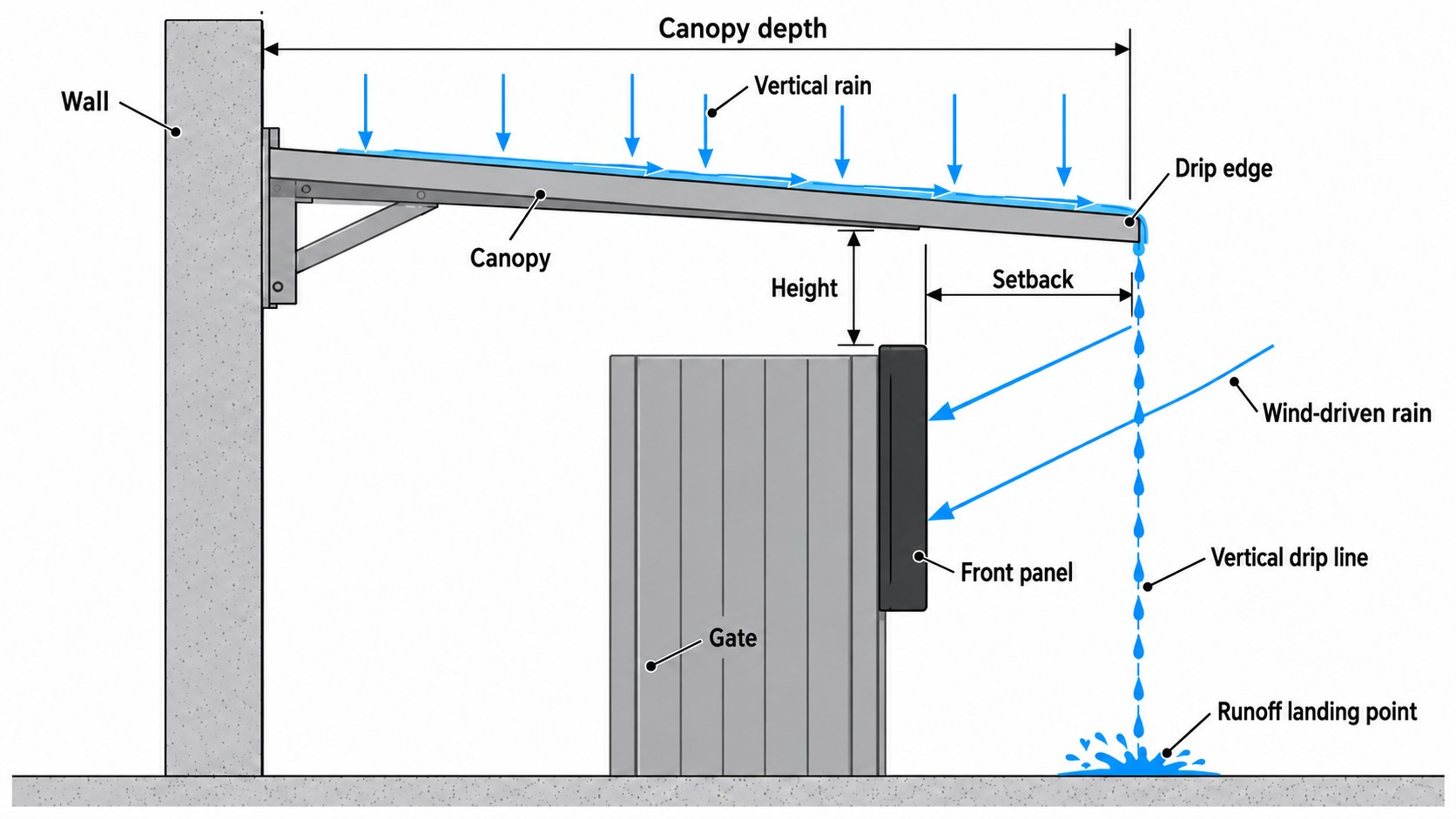
A recess keeps some rain off, but the water that does get in dries more slowly and is harder to see; a rear housing in a recess can stay damp long after the front has dried. Record ledges, low points and water arriving from above, and include the geometry with the photos wherever shelter is part of the case for an IP55 model.
5. Review Mounting, Drainage, and Drying Together
A spacer, mounting plate, field-drilled hole, cable entry or trim piece can add a joint that the tested enclosure never had. Work out where water could travel, whether a ledge or low point holds it, which gaskets and accessories the lock maker specifies, and which changes need their approval. Our fitting notes for outdoor locks are short: keep the panel gasket seated, seal unused holes in the door, and keep water running down the door from collecting at the lock (waterproof smart locks).
Look beyond the front face. Water can reach the top of a plate, track round trim, or sit in the recess after the exposed housing has dried. Where the back is out of sight, a section drawing or installation photo shows whether the hidden joint drains; until then it is recorded as unknown, because a dry outside says nothing about the inside of the assembly.
DOE's wall-penetration guidance explains how building flashing and water-control layers drain water outward.[3] For the gate itself, the reference is the lock maker's installation detail and, where needed, a project engineer's detail for the surrounding gate.
Do not seal every gap by default. An unapproved bead can block an intended drainage path, get in the way of service or depart from the instructions, so the lock maker says which joints are sealed, which stay open and which materials are allowed.
After installation, compare the accessible details with the approved drawing. If ordinary rain leaves visible water round a plate or in a recess, photograph it and send it for review.
6. Match IP Evidence to the Installed Assembly
IEC 60529 classifies the protection that enclosures give electrical equipment.[1] An IP claim is useful for a lock when its scope matches the product and arrangement you are buying: the model and variant, the assembly covered, the mounting orientation and the state of covers and ports, front and rear together or one housing only. A new hole, a substituted gasket or a different plate is a change to put to the lock maker before installation.
Within one model the version can change the rating: R2 is IP66 without the screen and IP55 with it (outdoor durability).
An IP rating says nothing about the canopy or the rest of the gate installation. Corrosion, condensation in a damp recess, sunlight on the finish and service life need their own evidence where the site calls for it. Temperature is stated per model: our IP66 models are rated −30°C to 70°C, the IP55 models −25°C to 60°C, except the R2 screen version, which is rated −30°C to 70°C.
What each digit means and how the ratings map to our models is set out in what IP ratings mean for outdoor gate smart locks.
7. Share the Site Details
Overall and close photos of both gate faces, the canopy or recess with the lock's position, and the rain, splash, irrigation and runoff paths marked on them are enough for a first recommendation. Add a side view of any shelter, and when the mounting is not standard, the drawing with holes, plates and cable entries and the positions of the battery cover and emergency port.
In return, the lock maker states which assemblies the rating covers for the quoted model, whether a sheltered-installation condition is met, which mounting arrangement and changes are approved, and what applies during servicing. “Suitable outdoors” answers none of these. Mark any point still open, such as an exposed rear assembly or a changed mounting detail, as unresolved.
8. Compare Two Installation Scenarios
Freestanding gate with no canopy
Take a freestanding steel gate in a garden wall, with no mortise pocket. The front panel takes direct rain, the rear housing is partly screened by the solid leaf, and irrigation reaches the lower mounting area. Record irrigation separately from rain, and photograph both housings. On an exposed gate like this we would start from L1, our surface-mounted IP66 rim lock for gates 35–65 mm thick, checking the support for its rear body and its 45 mm projection through the swing (outdoor gate smart locks).
If a proposed lock's instructions require shelter, the missing canopy is a specific mismatch to settle before purchase. If the model is rated for exposed use, the missing canopy is no reason to reject it; check the other installation conditions instead. Redirecting irrigation reduces the water on site, but it does not change what the lock is rated for.
Gate beneath a shallow canopy
Here the canopy stops vertical rain, but the front panel sits close to its edge. Wind-driven rain reaches it, and roof runoff lands near the gate. Record the setback and the runoff landing point, and check splash and retained water in the rear recess; calling the gate “sheltered” does not answer any of these.
The answer can be moving the lock within an approved mounting arrangement, dealing with the nearby runoff, or choosing a model rated for the exposure that remains. For a face recognition lock in this spot, for example, the R2 screenless version (IP66) fits the remaining exposure, while the screen version and R1 (IP55) are meant for covered doors. Once a site change is defined, send the revised drawing for confirmation; a promise that the gate will be “better covered” is too vague to confirm anything against.
9. Approve the Position Against Documentation
Before ordering or accepting installation:
- Classify each side and mark rain, splash and runoff paths.
- Identify mounting interfaces and openings, including those used during servicing.
- Check drainage and the places where water can stay.
- Compare the arrangement with the lock maker's permitted use and instructions.
- Settle differences in model, assembly, orientation, accessories or shelter before treating the configuration as approved.
Moving hardware, adding a cable entry or changing nearby drainage changes the arrangement that was reviewed, so it goes back for review.
Frequently Asked Questions
Can an outdoor smart lock be installed in direct rain?
Yes, when the model is rated for exposed use. For exposed positions we offer IP66 models, including A2, A11, L1 and the double-sided models, and recommend one from photos of the gate and the lock position. “Outdoor” in a product description is not enough; the rating, the assemblies it covers and the installation instructions are.
Is sheltered installation always better?
No. Shelter cuts direct rain, but runoff, splash or retained water can still reach the lock. A well-documented exposed installation with an IP66 lock is often on firmer ground than a poorly understood sheltered one.
How far should a smart lock sit beneath a canopy?
No single setback or canopy depth works everywhere. Record the dimensions and the rain direction and compare them with the model's conditions; when wind-driven rain still reaches the lock, choose an IP66 model.
Can I add a rain cover or extra sealant?
Only where the lock maker's instructions allow it. An added cover or sealant can block drainage or service access, so it is agreed as part of the approved configuration first.
References
- International Electrotechnical Commission, IEC 60529 — Degrees of protection provided by enclosures (IP Code). Enclosure classification scope.
- U.S. Department of Energy Building America Solution Center, Drainage Plane Behind Exterior Wall Cladding. Drainage behind wall cladding.
- U.S. Department of Energy Building America Solution Center, Flashing of Wall Penetrations in Existing Homes. Flashing and drainage around wall penetrations.
- U.S. Department of Energy Building America Solution Center, Gutters and Downspouts. Roof runoff and splash control.