Article contents 17 sections
Choose a single-sided smart lock when people need a credential only on the approach side and the release on the other side suits the gate's users and exit requirements. Choose a double-sided smart lock when both directions need a credential and the required exit arrangement still works. On our range that is, for example, the L1 rim gate lock for credentials outside only, and one of four double-sided models with a fingerprint, PIN and card reader on both faces.
The decision comes down to one question:
Who needs to operate the gate from each side, what action should each user take, what controls are physically reachable, and what must still work during normal exit, visitor access, service, and emergency conditions?
On many gates, a credential on the public side and a simple local release on the controlled side is the cleanest arrangement. On others, people legitimately come from both directions and both sides need control. On open-bar or mesh gates, the geometry can also put the controls on the far side within reach, which changes the security question. “Single-sided” and “double-sided” are only labels. Compare what each side of the quoted model actually offers: readers, credentials, permissions, fallback methods and behavior in an emergency. Choosing the lock format for the gate itself is covered in the outdoor gate smart lock selection guide.
1. Define the Two Sides Before You Compare the Lock
Name the two faces after the project, since “front” and “rear” get confusing once the gate is installed:
- public / approach side: where a resident, visitor, customer or delivery person arrives;
- controlled / interior side: inside the property, courtyard, compound or managed area.
On some projects both sides are public, and on others the “inside” is shared space. Naming the user groups works better than assuming one side is secure.
| Term | Meaning for the gate specification |
|---|---|
| One-sided credentialed access | One face has a credential input; the specification states how the other face opens |
| Two-sided controlled access | The quoted configuration has controlled operation from both faces |
| Exit-side operation | The normal action from the other side: a handle, button, credential or another stated method |
| Local fallback | A physical or local method that works when the normal access path is down |
| Reach-through exposure | Whether someone on one side can reach a control on the other side through or around the gate |
| Visitor / temporary access | A limited access path, with its creation, duration, revocation and side of use stated |
In these terms, single-sided means credential control on one named face and double-sided means control on both. Either way, check it against the lock maker's description of the rear handle, reader or release.
2. What Single-Sided Access Actually Means
Single-sided suits a gate where one side is the normal controlled entry and the other is a private or managed exit side. A typical case: residents arrive from the street and use their credential on the public side; the interior is a private courtyard; leaving needs no credential; visitors come in through a resident or visitor routine. There is only one credential face to run, which keeps operation simple.
Single-sided says where the reader is, not how people leave. The exit action can be a handle, button, thumbturn, credential, mechanical method or another release; name it in the specification. On our L1 rim gate lock, for example, the credentials are on the outside panel; if people inside need to open by PIN, L2 is the L1 version with a keypad built into the rear lock body.
Before settling on single-sided, the project answers:
- what a user does from the controlled side;
- whether that control can be reached from the public side through the gate;
- who uses the exit side in normal operation;
- what happens when the normal credential method is down;
- how visitors leave;
- how staff, contractors and maintenance use the gate;
- whether an egress, accessibility, pool, fire or other specialist requirement changes what exit behavior is acceptable.
3. What Double-Sided Access Actually Means
Double-sided suits projects that need controlled operation in both directions:
- a gate between two controlled areas;
- a perimeter gate used both ways by residents or staff;
- a service gate where contractors or maintenance staff come and go through controlled paths;
- a gate where an easily reached interior release would undermine the access design;
- a project where each side needs its own user permissions.
“Double-sided” can mean quite different hardware. For the quoted model, find out for each face: which credential methods each side has, whether the two sides use the same hardware, whether permissions can differ by side, whether temporary access works on one side or both, where the mechanical or local fallback is, how power or network loss affects each side, which emergency release remains, and whether both assemblies suit their physical and weather exposure.
On our range, credential capacity belongs to the whole lock: A2 Double-Sided holds 100 fingerprints, 50 PINs and 100 cards in total, so count the users of both faces together. Each double-sided model is also its own product: A2 Double-Sided uses a 6068 motorized mortise and a 5,000 mAh lithium battery, where the single-sided A2 runs on four AA batteries with a choice of four mortises.
4. More Authentication Is Not Always More Security
A second credential face solves some project problems and creates others. How secure the gate is follows from the whole system: its geometry, who can approach each side, whether controls on the far side are reachable, how normal exit works, the user groups, credential administration, the emergency release, physical fit, power and recovery, and any project safety requirement.
On a private villa gate with a solid leaf and a protected interior, a second credential face mostly adds steps. On a gate used both ways by staff and residents, it can be the right operating choice. And on an open-bar gate, the first question comes before any product choice:
Can someone on the public side physically reach a control that the access design assumes is protected?
5. Open-Bar, Mesh, and Wrought-Iron Gates Need a Reach-Through Review
On open gates the controls can be seen, or reached, through bars, mesh, decorative openings or round the edge of the leaf. The review covers:
- whether the far-side handle, button, reader, battery cover, cable or other control can be reached from the public side;
- how close the controls sit to an opening;
- whether the gate drawing includes a protective plate, shroud or other project detail;
- whether a proposed change of lock arrangement deals with the reachable control or only changes the number of readers;
- whether the whole gate has been reviewed, not just the lock.
Adding a rear reader does not protect the rest of the hardware: an opening can still expose the handle, button, cable or battery cover. When someone outside can reach through and work the inside handle or release, the options are a cover plate, a different handle position, or a double-sided model with credentials on both faces (outdoor gate smart locks).
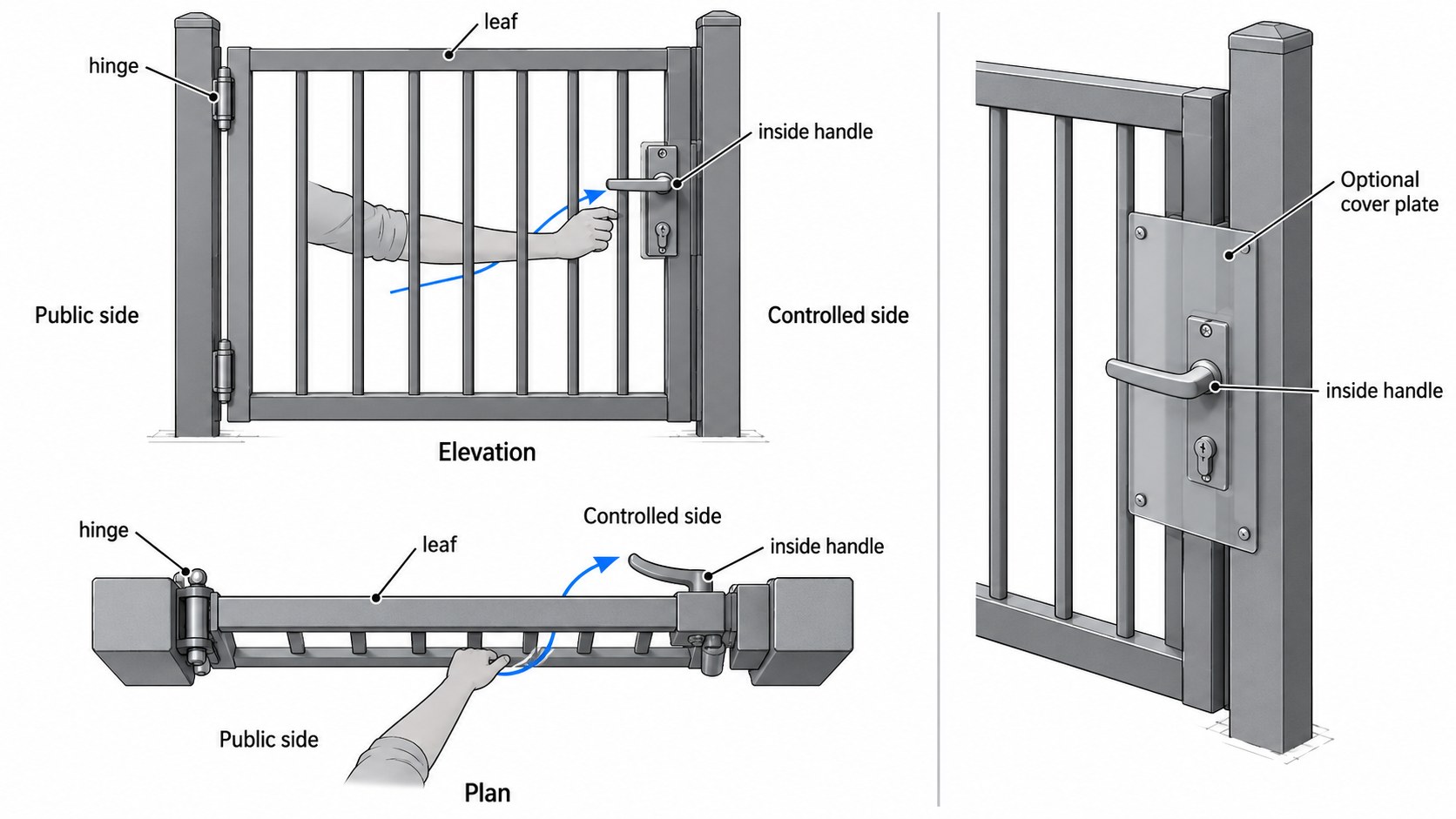
This is also where access control and life safety can collide. Even when a release is reachable, do not remove or block it until the egress and emergency requirements have been checked.
6. Map the Users Before You Map the Credentials
The right arrangement gets much clearer once the people who actually use the gate are listed.
| User group | Side normally used | Questions to answer |
|---|---|---|
| Residents / primary users | One or both | Do they need credentials in both directions? |
| Staff | One or both | Is leaving controlled, logged or free? |
| Visitors | Usually approach side | How are they let in, and how do they leave? |
| Contractors | Varies by project | Is access temporary, scheduled or supervised? |
| Maintenance / groundskeeping | Often service side | Do they need their own credential or fallback? |
| Deliveries | Usually approach side | Remote admission, temporary access or staff release? |
| Emergency / authorized response | Varies by project | Which local or specialist-defined release must stay available? |
The list catches a common mistake: designing the gate round the residents and forgetting staff, cleaners, groundskeepers, couriers and service technicians. Two-sided control brings more credential roles and more training; one-sided control is easier to run when a free or local release on the other side really suits the project.
7. Visitor and Temporary Access Are Workflow Questions, Not Proof of Architecture
Temporary access works on single-sided and double-sided locks alike, so start from the visit itself: which side the visitor arrives at; whether they need a reusable, one-time or time-limited credential; who issues it, when it expires and whether it can be revoked; whether they need a credential to leave; and whether the routine relies on the internet, a gateway, Bluetooth, a local PIN, a card or another method.
On our app versions (Tuya or TTLock), temporary codes are issued from the app; Bluetooth works near the lock, and remote access on TTLock versions needs a TTLock gateway and a Wi-Fi connection, so check the Wi-Fi signal at the gate before choosing. Test how the codes are issued and how they expire before approving the version, and tie each temporary access to a named side and user flow. The account and gateway side is covered in the app and gateway access management guide.
8. Keep Egress, Emergency Release, and Accessibility Separate From Convenience
A gate can be convenient to control from both sides and still need a different release arrangement for the project's safety or accessibility requirements; see fire door, egress and accessibility.
For U.S. projects, identify the adopted building code and edition before specifying the exit action; the International Building Code is one model-code reference used for that review.[1] Where the 2010 ADA Standards apply, Section 404 addresses doors, doorways and gates. Section 404.2.7 links door and gate hardware to the operable-parts requirements in Section 309.4, including operation with one hand without tight grasping, pinching or twisting the wrist.[2]
Gates are governed differently from place to place. The question goes to the responsible reviewer when the opening is part of a regulated egress path, an accessible route, a public or commercial facility, or anywhere else the access hardware affects required movement.
Four shortcuts are wrong:
- “single-sided always provides compliant exit”;
- “double-sided is not allowed on an exit”;
- “a mechanical key solves emergency egress”;
- “a rear handle automatically satisfies accessibility.”
Record the required exit action, the users who must be able to perform it and the release hardware approved for the opening, then assess reader placement, protective shrouds and credential rules against that arrangement. A design that solves reach-through by making the required exit action inaccessible has not solved the project.
9. Power, Network, and Recovery Still Affect Both Sides
A side decision that covers only normal operation is half done. For each side, state what happens when the battery is low, when normal power is lost, when the network or gateway is down, when the usual credential cannot be used, when the user has no phone, and when the local reader or electronics fail. Record which release methods remain on each side in each case; a working entry method does not mean the exit still works.
On our locks, fingerprints, PINs and cards already enrolled keep working within their validity when the network is down; remote changes need the connection. If the battery runs flat, a power bank on the 5 V Type-C port powers the lock temporarily, and the mechanical key is a second backup. Our double-sided models run on a rechargeable lithium battery, so on a gate the battery cover and Type-C port need to stay reachable once the lock is fitted.
Check What Users Can Still Do When a Service Fails
| Event | One-sided credential control | Two-sided credential control |
|---|---|---|
| Normal power is unavailable | Entry recovery, and whether the interior release works without power | Any shared power dependency, and the remaining action on each face |
| Network or gateway is unavailable | Whether local credentials still work and remote admission is lost | The same functions on both faces; two readers can still share one dependency |
| An administrator is unavailable | Who can admit a visitor, and whether the visitor can leave without them | The visitor's permitted direction, expiry and exit path, set before granting access |
| One credential is revoked | Rejection on the controlled entry face | Rejection on every face where it worked, and how the change reaches both |
Have these states demonstrated on the selected configuration. A mechanical interior release, an electronic exit button and a credential reader on the rear can have different dependencies even when their housings look alike.
10. Compare Entry, Exit and Recovery
| Decision area | One-sided credentialed access | Two-sided controlled access |
|---|---|---|
| Normal entry | Credential on one named side | Controlled action on both named sides |
| Opposite-side operation | Stated explicitly | Stated explicitly per side |
| User-flow complexity | Often lower when one side is private | Higher when roles or permissions differ by direction |
| Reach-through review | Critical if the local release can be reached | Still critical; a second reader does not protect other reachable controls |
| Both sides public | Can leave an uncontrolled or differently controlled path | Supports control both ways if the model's behavior fits |
| Visitor workflow | Often simpler when visitors leave by the local release | Can need exit rules or separate credentials for visitors |
| Staff / service workflow | Works when service users follow the same path | Useful when service users need control in both directions |
| Credential administration | Usually fewer controlled faces | More roles, side rules and records |
| Emergency / egress | Reviewed for the actual exit action | Reviewed when normal operation controls both directions |
| Power / recovery | Dependency often on one side | Both sides' dependencies and fallbacks |
| Weather exposure | The far-side hardware still needs checking | Both assemblies need their own exposure check |
| Product evidence | Side A method plus the exact side B release | Per-side methods, permissions, fallback and drawing |
Choose the arrangement that fits the gate's required movement, release action and the administration you can support.
11. What to Ask About Each Side
A request that names both faces gets a clearer answer. It covers:
| Evidence field | What the buyer needs |
|---|---|
| Exact model / variant | The quoted configuration, not just a category name |
| Side A operation | Credential methods and normal user flow |
| Side B operation | Credential methods or local release |
| Per-side symmetry | Whether methods and permissions really match |
| Gate drawing | Position of panels, handles, controls, lock body and openings |
| Reach-through review | Whether the gate geometry exposes far-side controls |
| Mechanical / local fallback | Side, action and limits |
| Temporary access | Method, side, duration, revocation and dependency |
| Power / network dependency | Which normal functions each side loses |
| Weather evidence | Whether each exposed assembly is covered |
| Egress / accessibility review | Status, where it applies |
| Open fields | Any behavior not yet shown for the quoted variant |
Close each field with evidence for the quoted variant; a category page or product photo is not enough.
12. Solid Villa Gate With a Private Interior Side
Take a solid villa gate. Residents arrive from the street and use their credential on the public side; the interior is a private courtyard; visitors come occasionally, and people normally leave from the courtyard. Single-sided fits if public-side entry is controlled, the interior release is clearly specified and out of reach from the public side, visitors can leave simply, and the project's safety requirements allow the intended release. A2 on a gate with a mortise pocket, or L1 on a gate without one, would be the usual starting point.
Double-sided is still an option, but the project should be able to say what the second credential face solves. A guest let in by a resident, for example, still has to leave after the resident has gone. With an approved interior release that works locally, a second reader adds a step to that visit for no gain. If the design instead needs a credential to leave, the guest receives an exit method before admission, and that arrangement has to fit the opening's egress requirements.
13. Open-Bar Service Gate Used by Staff and Contractors
Now take a metal service gate with open bars, used by employees and contractors, where the hardware on the controlled side can be seen through the leaf. The review covers which controls are physically reachable, who moves in each direction, whether staff leaving needs control, how temporary contractor access works, which emergency or egress requirement applies, and what the model does on each side.
Say a contractor gets a temporary entry credential valid until the end of a scheduled visit. If the same expiry disables the exit reader while the contractor is still inside, the routine has a hole; the authorized exit path and the response to an overrun are specified before two-sided control is chosen. Where the gate is a required egress opening, its approved release arrangement takes priority over recording departures.
The drawing also gets its own reach-through check. If an interior button, handle, cable or other release stays reachable, changing the readers does not remove the physical exposure, so any protective plate or shroud is reviewed together with the required exit action and user access.
14. A Practical Buyer Decision Sequence
Before asking for a final recommendation:
- Name side A and side B by user role.
- List who approaches from each side.
- Define the normal action on each side.
- Check whether any far-side control is reachable.
- Identify visitor, staff, contractor and service flows.
- Identify any egress, emergency, accessibility or local review.
- Ask what happens during power, network or credential failure.
- Check physical fit and exposure for both assemblies.
- Request model-specific evidence for each side.
- Compare candidates by what they mean for users, not by the label.
The chosen arrangement then carries into the gate fit, exposure and power review, so both sides stay usable in the intended conditions.
Frequently Asked Questions
Is a double-sided smart lock always more secure?
No. It gives controlled operation in both directions, but the gate's security still depends on its geometry, reach-through exposure, users, exit behavior, fallback and the exact model configuration. On a solid gate with a private interior, a single-sided lock is often the better fit.
Does double-sided mean fingerprint readers on both sides?
Not on every product, so check what each face offers. Our four double-sided models (A2, A11, A6 and R9 Double-Sided) have a fingerprint, PIN and card reader on both faces, with credential capacity shared by the whole lock.
Do open-bar gates always need double-sided locks?
No. Open construction calls for a reach-through review. A cover plate or a different handle position can solve it with a single-sided lock; a double-sided model is one of the options when the inside release cannot be protected.
Do visitor codes require an app or cloud connection?
On our Tuya and TTLock versions they are issued from the app. Bluetooth works near the lock; remote issuing on TTLock versions needs a TTLock gateway and Wi-Fi at the gate.
Specify the Action on Each Side
Write the action on each face into the specification: what a user does on side A, what they do on side B, what stays reachable through the gate, how visitors and service staff come and go, which egress and safety rules apply, and what still works without power or network. A single-sided lock fits when only one direction needs controlled entry and the release on the other side suits the project; a double-sided lock fits when both directions need control and the project can support the extra hardware, permissions, fallback and safety review. We show what the quoted model does on each side, and samples are available to fit on the actual gate before an order.