Article contents 12 sections
In a custom smart lock quote, tooling, NRE and MOQ are separate items. Tooling pays for physical production aids such as molds, dies and fixtures. NRE (non-recurring engineering) pays for one-time design, firmware or validation work. MOQ is a minimum that comes from a specific constraint, such as a finish batch, a print run or a component purchase. To compare quotes, sort every charge into one-time, per-unit, recurring or conditional, find the driver behind each minimum, and agree who owns any tooling you pay for.
The same word, “custom”, can mean a logo on an existing model or a new front panel with its own mold. Compared on unit price or one headline MOQ, those quotes look alike but price very different work. Many private-label projects need no new tooling: starting from an existing model with your logo or packaging is a practical way to launch, and for a custom design we go through tooling, development scope and MOQ with you. So the question to put to a factory is broader than “what is your MOQ?”:
What part of my customization creates the MOQ, what is a one-time cost, what repeats on future orders, and what do I own after I pay for it?
The answers come from the product, the customization, the process and the commercial agreement, so the figures below are worked examples; our prices are quoted per project. Defining the customization in the first place is covered in the OEM smart lock project preparation checklist.
1. Start by Classifying the Customization
Before discussing tooling or MOQ, define what changes. “Custom smart lock” can mean:
- adding a logo to an existing panel;
- using an existing finish in a buyer-specific color combination;
- creating a special surface treatment;
- changing the packaging and manual;
- changing a handle or housing dimension;
- creating a new front or rear panel;
- modifying a mortise-related component;
- changing electronics or firmware;
- adding a buyer-specific software or integration requirement.
Each customization gets its own line in the quotation, with the amount, deliverable, payment trigger, reuse conditions and responsible party. Start by classifying the request:
| Customization type | Typical buyer question | Possible commercial trigger |
|---|---|---|
| Artwork / branding | Is the physical product unchanged? | Artwork, marking or setup work |
| Finish / process | Is geometry unchanged but the process different? | Batch, material, finish or setup threshold |
| Packaging | Is hardware unchanged but packaging becomes buyer-specific? | Print quantity, insert, dieline or packaging setup |
| Mechanical | Does the physical part geometry change? | Engineering, tooling, fixture, validation |
| Electronics / firmware | Does hardware logic or electronics change? | Engineering, components, validation, development |
| Software / integration | Is the app, platform or integration scope changing? | Development, service, licensing or ongoing support |
A logo is usually not a tooling project
On an existing lock body and panel, a logo normally goes through an existing marking or printing process. It can still carry a setup charge or a minimum, on a much smaller scale than a new mold or mechanical part. The quotation says what changes in production; on our orders the logo is checked for size, position and contrast on the real surface before the branded version is approved.
A geometry change is different
Changing the shape of a front or rear panel, handle, plastic or metal part, seal, bracket, strike or other component goes deeper. The project can need some combination of:
- engineering work;
- drawings or design review;
- mold or die work;
- machining or forming fixtures;
- assembly fixtures;
- testing fixtures;
- samples;
- validation.
The combination follows how the part is made: a die-cast zinc alloy part and a formed stainless steel part, for example, need different tools. In our Jinhua factory, laser cutting, stamping, hydraulic forming, welding and CNC machining are done in house, while die-cast parts come from qualified suppliers, so a die-cast change brings a supplier's tool into the quote. See SUS304 vs zinc alloy smart locks.
A buyer needs no tooling expertise, only a clear map of which change creates which charge.
2. Separate the Cost Layers Before Comparing Quotes
Putting every charge other than the unit price into one bucket called “tooling” makes quotations impossible to compare. Separate four layers instead.
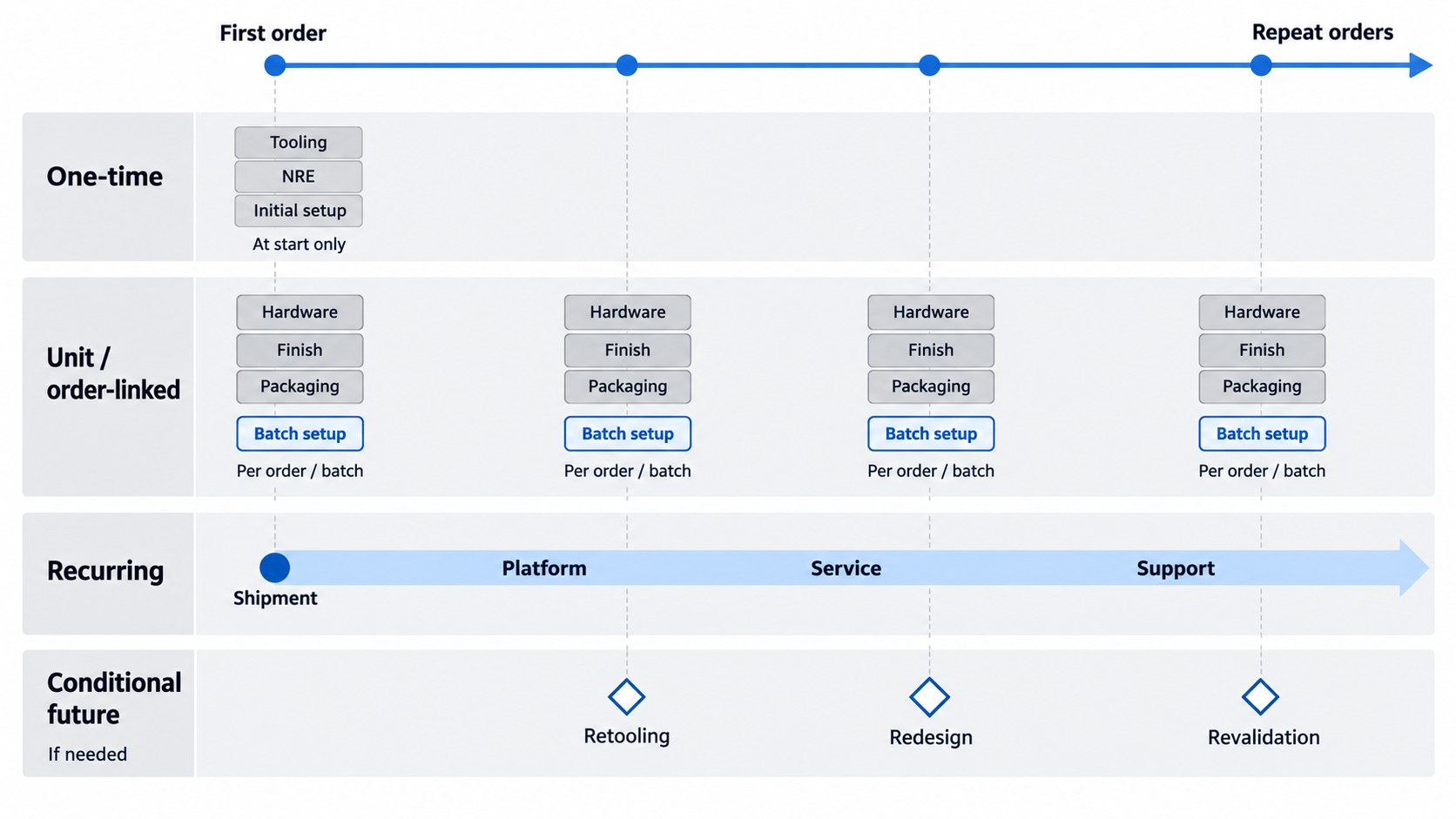
| Cost layer | What it can include | Question to ask |
|---|---|---|
| One-time | Tooling, engineering/NRE, initial setup quoted as a one-time charge, development, special validation | Do I pay this again on a repeat order? |
| Per-unit or per-batch | Hardware, custom parts, finish, packaging, accessories; batch setup where it is charged per order or production batch | How does this change with quantity and with each new batch? |
| Recurring | Platform, software service, support, licensing where applicable | Does this continue after shipment? |
| Conditional future | Retooling, redesign, revalidation, new packaging version | What event creates another charge? |
Many projects have only two or three of these; each charge still sits in its own layer.
Tooling is not the same as NRE
NRE (non-recurring engineering) covers one-time engineering, design, firmware, validation or project work. Tooling usually means a physical production asset such as a mold, die, fixture or jig. Quotations use these names loosely, so each charge should say what it pays for:
- Is it a physical mold?
- Is it a machining fixture?
- Is it engineering time?
- Is it firmware development?
- Is it a testing fixture?
- Is it a sample-development charge?
- Is it a packaging die?
- Is it simply a one-time production setup charge?
Each line is easier to judge when it names the deliverable as well as the fee.
3. Understand the Difference Between Mold, Tooling, Fixture, Jig, and Setup
The terms are used loosely; for buying, they only need to be commercially clear.
Mold
A mold shapes a part in a molding process. A new molded housing or other molded part usually needs a new or modified mold; an existing tool that can be adjusted keeps the cost down.
Die
A die is used for forming, stamping or cutting. A custom metal part or packaging insert often needs one.
Fixture
A fixture holds or locates a part during manufacture, assembly, inspection or testing. A project can need a new fixture without a new mold.
Jig
A jig guides or controls an operation. Quotations mix “fixture”, “jig” and “tooling” freely.
Setup
Setup is broader. It can cover:
- marking equipment;
- a finishing process;
- printing files;
- assembly instructions;
- test parameters;
- packaging;
- production documentation.
Some setup involves no physical tool at all. So the better question is wider than “is there a mold charge?”:
What one-time assets or setup work are required by this customization, and what exactly will I receive or retain from each charge?
4. MOQ Is Usually a Result of a Constraint, Not Just a Number
One MOQ figure hides the reason behind it, and different parts of one project can have different thresholds. Typical drivers:
- production setup;
- raw material purchasing;
- bought-in component quantities;
- finish or coating batch size;
- custom color preparation;
- printed packaging;
- custom inserts;
- electronic modules;
- special accessories;
- supplier policy;
- platform or software commercial terms.
So the hardware MOQ and the packaging MOQ can be two numbers. Find the driver behind each minimum. Electronic modules, motors and fingerprint sensors in our locks come from qualified module suppliers, so a component change can bring that supplier's purchase quantity into the minimum.
| MOQ driver | What creates the threshold | What to clarify |
|---|---|---|
| Hardware production | Line/setup efficiency or supplier policy | Is this standard-model MOQ or custom-project MOQ? |
| Material / component | Supplier or sub-supplier purchase quantity | Which component creates the minimum? |
| Finish / color | Batch or process setup | Is the threshold tied to one finish or total order? |
| Packaging | Print run, box, label, insert | Can packaging MOQ differ from hardware MOQ? |
| Electronics | Module or component purchase quantity | Is the threshold configuration-specific? |
| Software / service | Development or commercial package | Is this an MOQ, a fee, or a service condition? |
“Custom MOQ” is often several numbers
A small hardware quantity on an existing model can sit next to a custom printed box with a higher print minimum. Or the reverse: simple packaging, but a custom finish or bought-in component sets the higher threshold. If the quotation lists one MOQ, find out what it covers.
5. Keep Sample Quantity, Trial Order, and Production MOQ Separate
Samples, a trial order and a production order are three stages. Sample quantity answers questions about fit, function, configuration, appearance, packaging or integration; production MOQ reflects the conditions of the production run. A few development samples are often possible while a custom material, finish, component or packaging run needs a larger production quantity. Paying for a sample does not settle the production tooling, MOQ or terms.
Label each quantity by its purpose; how to plan a sample order covers sample planning in depth.
6. Ask What Actually Drives the First-Order Price
The first custom order usually costs more per lock than a repeat order, because it carries one-off work:
- engineering;
- tooling;
- project setup;
- packaging preparation;
- software development;
- validation;
- samples.
A repeat order drops some of those items, as long as the product, tooling, materials, software scope, packaging and commercial arrangement stay the same.
First-order cost is not repeat-order cost
When comparing quotations, get four separate figures:
- one-time project charges;
- unit price;
- recurring charges;
- future conditional charges.
A higher first quote with a clear one-time scope is easier to judge than a lower one that hides work in vague assumptions and costs more later.
Worked Example: First Order and Repeat Order
Take a quotation with USD 6,000 of one-time engineering and tooling plus USD 90 per complete lock, for 300 locks. The initial subtotal is USD 6,000 + 300 × USD 90 = USD 33,000, or USD 110 per ordered lock.
If the quotation confirms that the same configuration and tooling remain usable, no further setup charge applies, and the USD 90 unit price still applies, an identical repeat order totals USD 27,000, or USD 90 per lock. Freight, tax, recurring software fees, financing, and later modifications are excluded from both subtotals. Tooling ownership and any refund are separate agreed terms, whatever the first payment covered.
Higher volume spreads tooling cost; it does not remove it
A larger order spreads fixed setup costs over more units, and the tooling is still paid for somewhere. The quote can:
- charge tooling upfront;
- embed some or all of it in unit price;
- credit part of it after a volume target;
- fund it in exchange for a purchasing commitment;
- reuse an existing tool and charge only modification work.
Get the arrangement in writing, and keep a dated scope and approval record so later changes can be compared with the quotation's assumptions.
7. Tooling Payment and Tooling Ownership Are Different Questions
This is one of the most important points in a custom project. Paying for tooling does not settle these; each has to be agreed in writing:
- who owns the asset;
- where it is stored;
- who may use it;
- whether it is exclusive to the buyer;
- whether it can be transferred;
- who maintains it;
- who approves modifications;
- what happens when the project ends.
A tooling record can include:
| Field | What to confirm |
|---|---|
| Tool / asset description | What physical asset does the charge cover? |
| Tooling ID | How will the asset be identified later? |
| Payer | Who pays the charge? |
| Owner | Who owns the asset under the agreement? |
| Storage | Where is it kept? |
| Exclusivity | Can it be used for another customer or product? |
| Maintenance | Who pays routine maintenance or repair? |
| Modification | Who can approve changes? |
| Transfer / retrieval | Can it be moved or retrieved, and under what conditions? |
| End of project | What happens if the project is discontinued? |
The payer, owner, holder and user of a tool can be four different parties unless the agreement says otherwise.
8. Amortization, Credits, and Refunds Need Written Conditions
Quotes and sales calls often use phrases such as:
- “tooling will be refunded later”;
- “the mold cost can be credited”;
- “we can amortize it into the unit price”;
- “there is no tooling fee above a certain volume.”
These can be legitimate arrangements, but each needs its conditions written down:
- the exact amount involved;
- the quantity or revenue threshold;
- whether the threshold applies to one order or cumulative orders;
- the time period;
- which SKUs count;
- whether cancellations affect the credit;
- whether redesign creates new tooling;
- whether the credit changes ownership;
- whether the unit price changes after the credit.
If tooling is described as free or included in the unit price, the cost is recovered somewhere; get the mechanism and its conditions in writing.
Amortization changes cash flow, not necessarily the total
Tooling built into the unit price means less upfront and more per unit for a while. That helps cash flow, but makes repeat-order prices hard to compare unless the quote states when the amortization ends and what the unit price is afterwards.
9. Packaging and Software Can Have Their Own Commercial Thresholds
A physically standard lock can still carry custom work outside the hardware.
Packaging
Custom boxes, inserts, manuals, labels or printed materials can have:
- print quantities;
- setup charges;
- dies or tooling;
- the printer's own minimums.
Those minimums can differ from the hardware MOQ.
The packaging asset workflow is covered in the private-label branding and packaging checklist; here, the point is the commercial line it gets.
Software and integration
A branded app, custom software, firmware, API or integration work, or platform changes can bring:
- one-time development work;
- validation;
- recurring platform/service charges;
- maintenance/support obligations.
None of those are tooling. Keep them in their own rows instead of inside a generic “tooling” line; the scope itself is covered in app branding vs hardware branding.
10. Compare Quotes by Scope, Not by Headline MOQ
Compare quotations field by field. Mark a required charge that was left unanswered as “awaiting quotation”; zero and “included” are both guesses. For engineering, setup, and tooling, record the deliverable, payment trigger, and conditions under which the charge recurs.
| Quote field | Quote 1 | Quote 2 | What to compare |
|---|---|---|---|
| Base product / configuration | Same technical scope? | ||
| Customization scope | Same changes included? | ||
| Unit price | Same quantity and configuration? | ||
| MOQ | Same driver and same order stage? | ||
| Tooling / physical assets | Tool ID, process, deliverable, ownership and reuse conditions? | ||
| NRE / engineering | What development work is included? | ||
| Setup | Which preparation is one-time, and which repeats per order or batch? | ||
| Packaging | Standard or custom? Separate minimum? | ||
| Software / platform | One-time or recurring? | ||
| Validation / testing | Included or separate? | ||
| Ownership terms | Who owns/controls tooling? | ||
| Lead time | Tooling, sample and production separated? | ||
| Repeat-order terms | What cost disappears or remains? |
Fill the blank columns from the actual quotations.
Watch for one label covering different scope
One quote's “tooling” includes engineering, tooling, first samples and validation; another's covers only the mold, with engineering charged separately. The headline tooling figures mean nothing until the deliverables are lined up; the full method is in the quotation comparison guide.
11. Five Customization Scenarios to Test a Quote
The same word, “custom”, produces very different commercial structures:
Scenario A: Existing lock + buyer logo
The hardware geometry is unchanged, as with a logo on one of the starting models on our OEM/ODM page, such as the A2 IP66 waterproof smart lock or, for apartment ranges, the G1 apartment smart lock.
Questions:
- Is the logo process already available?
- Is there a marking/setup charge?
- Is there a branding MOQ?
- Does packaging also change?
- Is a branded sample required?
This is mainly artwork and setup; hard tooling rarely comes into it.
Scenario B: Existing lock + custom finish
Geometry is unchanged, but production process changes.
Questions:
- Is the finish already part of the factory's process?
- Does it require a separate material or finish batch?
- Is there a color/finish minimum?
- Are samples required for appearance approval?
- Does the finish change unit cost on repeat orders?
The Canadian door brand on our development capabilities page is a real case of this kind: it kept one of our established outdoor platforms and changed the surface texture, branding and packaging. We reached the texture with existing processes and limited tooling adjustments, without a new set of structural molds, and the modified surface process still went through three samples, two rounds of appearance approval and additional validation. The first order was 450 sets; that was the customer's quantity, and our minimum is quoted per project.
Scenario C: New front-panel geometry
The physical part changes.
Questions:
- What engineering is required?
- What tooling or fixtures are required?
- Which parts are new?
- What validation is needed?
- Who owns the tooling?
- What happens if the geometry changes after sampling?
This is much closer to a real tooling project.
Scenario D: Standard hardware + custom packaging
The lock is standard, but the box, insert, manual and label are custom.
Questions:
- Is hardware MOQ unchanged?
- What is the printer's minimum?
- Does the insert require a die or setup?
- Is packaging billed separately?
- What changes on a repeat order?
Scenario E: Standard hardware + custom app or integration
The physical lock uses an existing configuration while the digital scope changes.
Questions:
- Is the charge development, setup, platform, or recurring service?
- Does the requirement affect firmware?
- Does it have a commercial threshold different from hardware MOQ?
- What remains payable after the first order?
This is a development and service question, with no mold involved. On our locks a dedicated app, white-label interface, firmware change or connection to your own system is scoped with our module and software partners before anything is promised.
12. What to Confirm Before Approving Tooling or Custom MOQ
Before approving a custom project, you should be able to answer five groups of questions.
Scope
- What exactly changes from the standard product?
- Which parts remain standard?
- Which deliverables are new?
Cost
- Which charges are one-time?
- Which are per-unit?
- Which are recurring?
- Which may return if the design changes?
MOQ
- What creates the minimum?
- Is it hardware, material, finish, packaging, component, software or company policy?
- Does sample quantity differ from production MOQ?
Ownership
- Who pays?
- Who owns?
- Who stores?
- Who maintains?
- Who can modify?
- Can the tooling be transferred or retrieved?
Repeat order
- Which first-order charges disappear?
- Which remain?
- Does unit price change after amortization?
- Can the same tooling be reused?
- What event would trigger retooling or reapproval?
Where the quotation leaves one of them blank, the commercial picture is still incomplete.