Article contents 18 sections
To choose a smart lock for a glass or aluminum-profile door, first decide what carries the lock and what receives its latch or bolt. A lock clamped to glass and a lock fixed to the narrow metal stile around a glass panel are checked in different ways.
For frameless glass, the questions are the glass construction and thickness, existing holes or patch fittings, the edge, the meeting gap, and where the keeper can sit.
For an aluminum-profile or narrow-stile door, they are the usable flat width, the profile depth, glazing beads and gaskets, what is inside the section, the existing cutout, and whether the lock body physically fits in it. Door thickness alone settles neither case.
The sequence:
identify the door construction → choose the glass or profile fitment path → record the application-specific geometry → identify the receiving surface for the keeper/strike → compare the exact lock configuration and drawing → stop for specialist review if the door still requires fabrication
Handing and frame condition matter too; this guide concentrates on the mounting and receiving surfaces, which is where glass and profile doors differ.
First Decide What the Lock Is Actually Mounting To
Classify the door by what the lock fixes to, not by what fills most of the opening. A door with a large glass panel may still be an aluminum-profile door if the smart lock mounts to the aluminum stile rather than directly to the glass. A frameless glass leaf with a clamp or patch fitting follows a different route. A framed glass door may combine both systems.
Start with three questions:
- Is the lock mounting directly to glass, to an aluminum profile, or to another frame member?
- Is the door single-leaf or double-leaf?
- What surface will receive the keeper or strike when the door closes?
Those answers determine which dimensions matter next.
Treat sliding glass as a separate hardware path
This guide is mainly about swing-door fitment.
Sliding glass systems use hook locks, tracks, overlaps and jambs that a swing-door checklist does not cover. If the door slides, say so at the start; it needs sliding-door hardware.
Glass and Aluminum Profile Doors Fail Fitment for Different Reasons
| Fitment question | Frameless / directly mounted glass | Aluminum profile / narrow stile |
|---|---|---|
| Primary mounting surface | Glass leaf | Aluminum stile/profile |
| First dimension to understand | Glass thickness and mounting geometry | Usable flat stile width and section depth |
| Existing preparation | Holes, notches, patch/clamp footprint | Cutout, mortise pocket, screw holes, old panel footprint |
| Hidden condition | Glass fabrication status / existing holes | Internal cavity, reinforcement, thermal break, glazing channel |
| Common obstruction | Edge clearance, adjacent fitting, meeting gap | Bead, gasket, edge return, narrow face, shallow cavity |
| Pair-door issue | Glass-to-glass keeper and meeting gap | Meeting stile, overlap/astragal, receiving face |
| Drawing needed for review | Selected glass fitting / lock drawing | Selected panel + lock-body / mortise drawing |
The table tells you what to measure. The fit itself is decided against the chosen lock, its accessories and the current drawing.
Glass Door Path: Framed or Frameless Comes First
For a glass application, determine whether the smart lock will interact with:
- frameless glass;
- glass inside an aluminum or metal frame;
- a patch fitting or clamp system already attached to the glass;
- an existing drilled preparation;
- a mixed condition where the lock is on a profile but the keeper or opposite leaf is glass.
Glass-door fitting systems use different mounting arrangements. DORMA-Glas, for example, describes fittings that combine prepared glass holes with clamping; “clamping” does not necessarily mean “no drilling required.”3 A smart lock's glass fitting is the same: the model drawing shows whether it clamps, uses holes, or both. A framed glass door often takes a profile-mounted lock and is treated like a narrow-stile aluminum door.
“Glass door” is too vague to quote against. A useful description reads like:
Frameless swing glass leaf, single door, existing clamp lock, keeper on fixed aluminum frame
or:
Aluminum-framed glass door, lock mounted to a narrow stile, existing mortise cutout; usable face width measured beside the glazing bead
The second description makes it obvious that the critical fitment surface is the profile, not the glass panel.
Confirm the glass construction as well as its thickness
Record whether the leaf is monolithic or laminated and whether it is tempered. These are separate facts: laminated describes the layers, not whether each ply is tempered. Take them from the door records, the glass mark or the glass fabricator, because clear glass all looks the same.
A fitting rated for 10 mm glass is checked against the actual make-up too, including any coating where the clamp grips.
Glass Thickness Matters, but It Is Model-Specific
For a lock mounted directly to glass, measure and record the actual glass thickness at the mounting zone.
Our A7 glass door smart lock fits frameless glass 8–12 mm thick with a 4–15 mm gap, and framed doors 30–120 mm thick across its versions, with optional no-drill clamps for frames 15–50 mm. Those ranges belong to A7 and its fittings; we confirm the configuration and accessories against the actual opening. The glass door smart locks page compares the mounting routes.
Glass thickness screens a candidate. The order then names:
- exact model and variant;
- clamp, patch, or other mounting route;
- gasket/pad arrangement where applicable;
- allowable meeting gap;
- keeper or strike arrangement;
- current drawing or preparation sheet.
Clamp Route and Drilled-Glass Route Are Not the Same Thing
A configuration designed and documented for no-drill clamping avoids new holes in the glass. “Patch fitting” on its own does not mean no-drill; some patch fittings need prepared holes.
A clamp still needs dimensions:
- glass thickness;
- available engagement area;
- distance to the glass edge;
- nearby patch fittings or hinges;
- meeting gap;
- old clamp footprint;
- keeper surface;
- leaf overlap or alignment;
- exact clamp/accessory selection.
A drilled-glass route adds another constraint: the hole or cutout pattern must match the selected hardware.
Treat existing glass holes as a fixed part of the opening geometry. Record the hole count, location, size/shape, edge relationship, and the hardware they currently serve.
If the candidate lock uses a different pattern, compare its drawing with the glass and bring in the glass fabricator before anything is changed.
Heat-Treated Glass Changes the Decision About New Holes
This is one of the most important differences between glass-door fitment and an ordinary wood or metal retrofit.
The National Glass Association’s GANA Glazing Manual states that heat-strengthened and fully tempered glass cannot be cut, drilled, or edged after heat treatment; required fabrication such as holes and cutouts is performed before heat treatment.1
An installed tempered leaf cannot take a new hole during lock installation. For an existing glass door, establish:
- Is the glass tempered or otherwise heat-treated?
- Are the required holes already present?
- Does the selected lock use those exact holes?
- Is a clamp/no-drill configuration available for the selected model?
- If new glass is required, who controls the glass fabrication drawing?
If the existing preparation does not match, the options are a configuration that uses the existing holes or clamps, or replacement glass prepared for the chosen lock.
Check the Glass Edge, Meeting Gap, and Keeper Surface
The lock on the active leaf is half the fit; the other half is what receives the latch. For a single frameless glass leaf, the keeper may be supported by:
- a fixed aluminum frame;
- another metal receiving surface;
- a wall-side fitting;
- a dedicated glass hardware component.
For a double-glass opening, the opposite leaf may carry the keeper or receiving hardware.
Record the door closed, not only open.
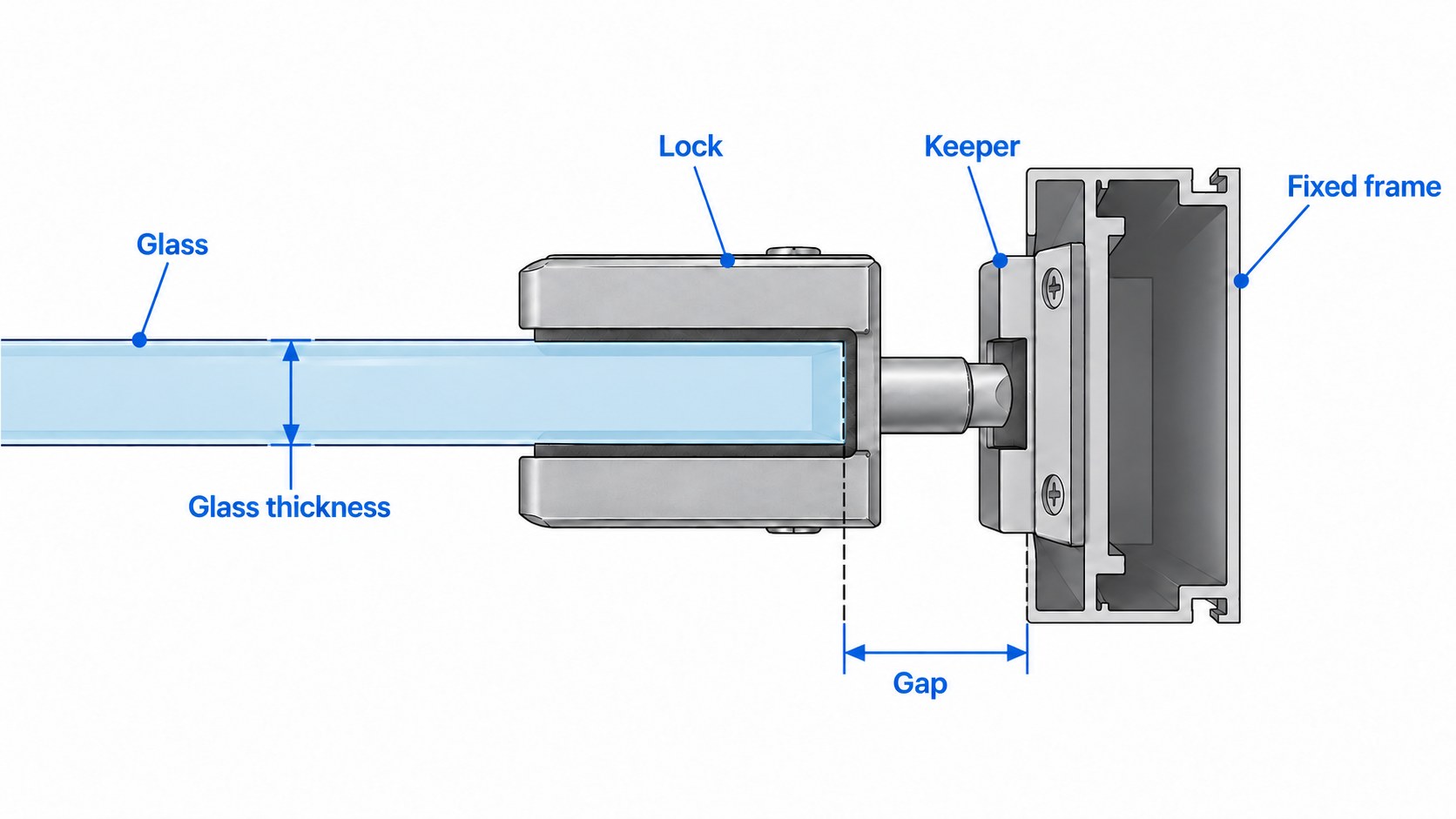
Photograph and measure:
- straight-on photo of the closed meeting edge;
- close-up of the receiving surface;
- measured gap or overlap;
- active and passive leaf identification;
- existing patch fitting or keeper footprint;
- full photo of both leaves;
- candidate lock model.
For a glass-to-glass pair, check whether the selected lock and keeper support that arrangement.
Aluminum Profile Path: Measure the Usable Face, Not the Nominal Frame Width
For narrow-stile aluminum doors, the outside profile dimension can be misleading.
What matters for the smart-lock panel is the usable flat mounting face at the actual lock location.
A profile may appear wide enough until part of that width is occupied by:
- a glazing bead;
- gasket;
- edge return;
- decorative cap;
- door stop;
- existing hardware;
- curved or stepped extrusion geometry.
Measure the area where the panel would actually sit.
Record the overall stile face width and the uninterrupted flat mounting width beside the glazing bead as separate measurements. Show their boundaries in a close-up photo. That lets us compare the panel footprint with the surface actually available.
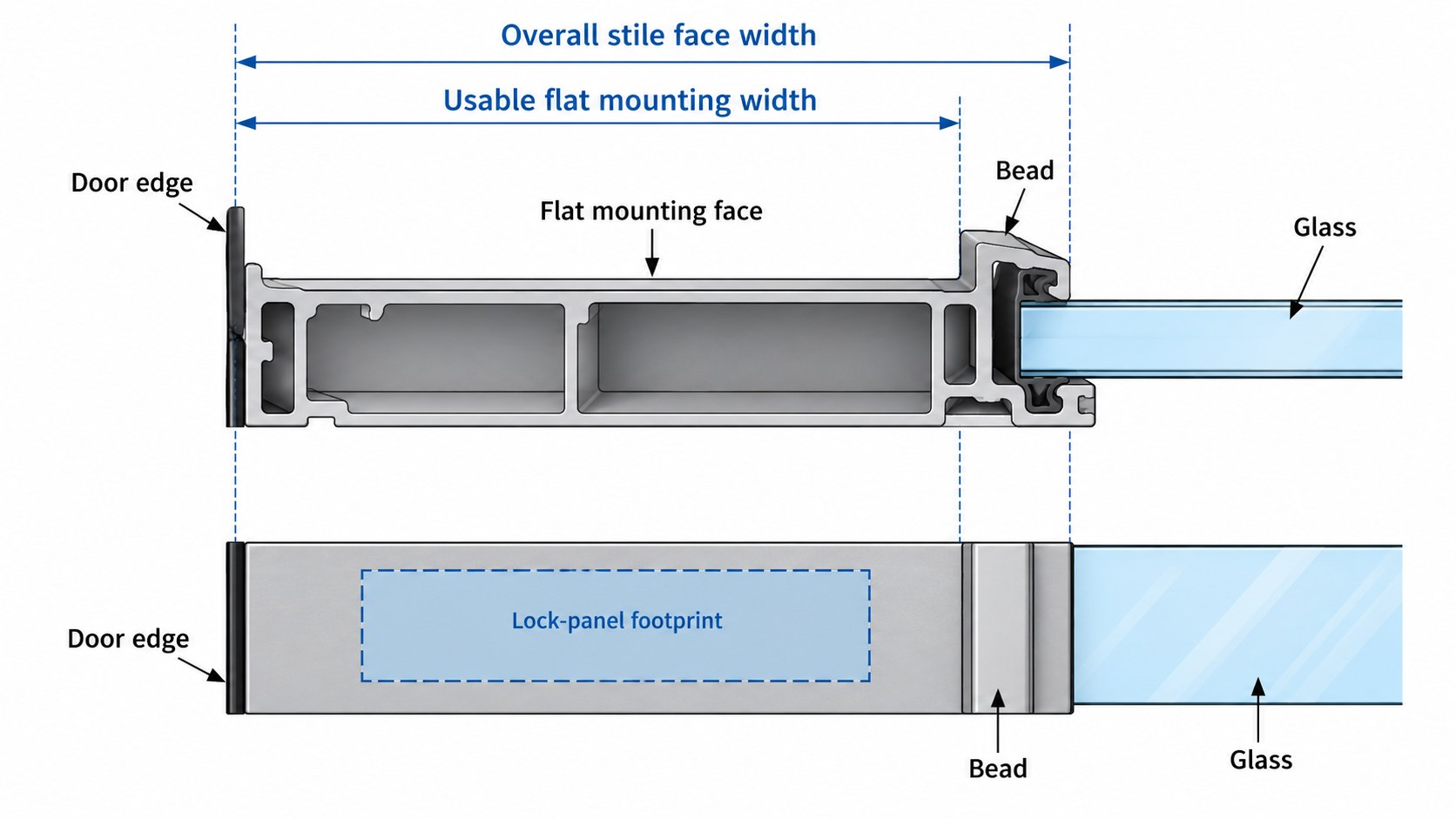
Official narrow-stile hardware documentation also treats dimensions such as backset, case size, faceplate, and strike as separate product-specific fields rather than deriving them from one exterior stile width.2
Profile Depth and Internal Section Matter Too
A panel that fits the front face can still fail because the selected lock body does not fit inside the profile.
Record, where accessible:
- profile/stile face width;
- usable flat width;
- section depth;
- existing cutout;
- old faceplate;
- visible cavity;
- glazing channel position;
- bead/gasket intrusion;
- signs of reinforcement;
- meeting stile geometry.
A solid-looking extrusion can be hollow behind the face, so check the reinforcement where the fixings land. When the inside is not visible, the profile section drawing from the door fabricator is compared with the lock-body drawing, the fixings and the glazing clearance. A photo of the front face cannot show that.
Panel Width Is Not the Same as Profile Compatibility
A narrow panel is easier to place on a narrow stile, but the width is one of several checks:
- panel depth and handle clearance;
- fixing locations;
- existing holes;
- lock-body depth;
- faceplate position;
- glass-side interference;
- gasket/bead position;
- remaining material around the cutout;
- keeper/strike alignment.
Our A11 profile door smart lock, for example, has 290 × 40 mm front and rear panels for doors 40–90 mm thick. The panel size tells you what must sit on the face; we then check the fixings, lock body, clearances and keeper against the actual profile. Our aluminum profile door smart locks page compares the profile models.
Framed Glass Doors Often Become a Mixed Fitment Problem
A framed glass door sits between the two simple paths.
The leaf contains glass, but the lock may mount entirely to the aluminum profile. In that case:
- glass thickness may matter for the door system;
- profile usable width controls the panel;
- profile depth affects the lock body;
- glazing bead/gasket affects clearance;
- the keeper may land on a frame or another profile;
- the glass itself is often not touched at all.
Classify the mounting surface first.
If the lock mounts to aluminum, use the profile fitment path. If the lock clamps directly to glass, use the glass path. If the lock and keeper use different materials or leaves, treat the opening as a mixed fitment and document both sides.
Double-Leaf Doors Need a Receiving-Surface Decision
Whether the opening is glass or aluminum profile, a double leaf adds another question:
What exactly receives the latch, bolt, or keeper when the active leaf closes?
For a glass pair, that may be the passive glass leaf through a dedicated fitting.
For an aluminum-profile pair, it may be:
- the passive meeting stile;
- an astragal or overlap condition;
- a surface-mounted receiving component;
- another profile element.
Record:
- active leaf;
- passive leaf;
- lock-carrying leaf;
- meeting edge/stile;
- closed-state gap or overlap;
- receiving material;
- existing keeper/strike;
- photos of both leaves closed;
- candidate hardware.
The passive leaf also has to hold its closed position. Record what secures it and whether the meeting edges line up every time. A leaf that moves or sags is a door repair first; a bigger keeper will not make up for it.
If both leaves open in daily use, say so at the start, because a keeper that works with one leaf bolted shut may not suit that.
Three Common Retrofit Decisions
A frameless glass leaf with holes from an old lock
The glass thickness is within a candidate lock's range, but the hole pattern differs from the old lock's. Compare the existing holes with the new fitting drawing. On tempered glass the holes cannot be enlarged or moved,1 so the choice is a configuration that uses them, a no-drill clamp that clears them (with its own edge, gap and keeper check), or new glass.
A wide-looking aluminum stile with a narrow flat face
The stile face measures 52 mm, but the glazing bead and edge return leave 39 mm of flat surface at the lock position. A 40 mm panel does not fit just because 40 is less than 52; it overhangs the flat area by 1 mm.
Even a narrower panel leaves the fixings, what sits behind them, and whether the lock body clears the glazing channel. The section drawing and the cutout details answer those, alongside the two widths.
A double-glass opening with no fixed jamb at the meeting edge
The glass lock fits the active leaf, but the keeper quoted with it is for a fixed metal frame, and here the receiving surface is the other glass leaf. The opening needs a glass-mounted keeper for that leaf and the measured gap.
Photograph both leaves closed, mark which one normally stays shut and what holds it. The answer is a different keeper, a different lock, or a door-system change; ordering the lock alone leaves half the fit open.
What to Record for Each Door Type
| Field | Glass path | Aluminum-profile path |
|---|---|---|
| Door ID / leaf arrangement | Required | Required |
| Full closed-door photos | Required | Required |
| Existing hardware | Clamp/patch/holes/keeper | Panel/mortise/cutout/strike |
| Primary surface measurement | Glass thickness and edge/gap geometry | Usable flat stile width and profile depth |
| Existing preparation | Glass holes, notches, patch footprint | Holes, mortise pocket, faceplate, old panel footprint |
| Hidden uncertainty | Fabrication status / unseen hole compatibility | Internal cavity / reinforcement / thermal break |
| Pair door | Glass-to-glass gap and opposite fitting | Meeting stile, overlap/astragal, receiving face |
| Model drawing | Glass fitting / lock / adapter | Panel / mortise / lock body / keeper |
Keep the photos, dimensions and candidate model under the same Door ID, and mark hidden fields as unknown, for example “profile reinforcement unknown” or “tempered-glass hole pattern not checked”. An honest unknown tells us what to check next; a guess does not.
Know When to Stop Before Ordering
Hold the order while any of these is open:
- glass thickness is unknown;
- existing glass holes are not mapped;
- new glass fabrication would be required but no fabricator has reviewed it;
- usable profile face width is uncertain;
- profile depth/internal section is unknown;
- the panel appears wider than the flat stile;
- the selected lock body has not been checked against the profile section;
- the receiving surface for the keeper is unclear;
- the pair-door keeper has not been checked;
- an existing patch, mortise, or cutout conflicts with the candidate drawing;
- the opening is fire-rated, on an escape route, subject to accessibility rules, or otherwise needs specialist review.
Frequently Asked Questions
Can I use a clamp smart lock on any frameless glass door?
No. Each clamp lock has its own glass thickness and gap range, and the fit also depends on the edge and grip area, nearby fittings and the keeper surface.
Can existing holes in a glass door be reused?
Yes, when the new lock's fitting drawing matches the existing holes and the clamp area, meeting gap and keeper also suit the configuration. Map the holes first and compare them with the drawing.
Can tempered glass be drilled for a new smart lock after the door is installed?
No. NGA guidance says heat-strengthened and fully tempered glass is cut, drilled and edged before heat treatment, and that cutting or drilling afterwards breaks it.1 If the existing holes do not match, use a configuration that fits them, a no-drill clamp, or new glass from the glass fabricator.
Which width should I measure on a narrow aluminum profile?
Measure the usable flat mounting face at the lock position, not only the maximum outside width of the extrusion. Also record bead/gasket intrusion, edge returns, existing hardware, and the profile section/depth.
What if the aluminum profile is hollow?
Then the fixings need reinforcement where they land, which the outside does not show. The profile section drawing, or photos of an existing cutout, let us check the fixings and lock body against it.
Does a narrow lock panel guarantee fit on a narrow stile?
No. Panel width is only one constraint. Profile depth, fixings, existing preparation, glazing clearance, lock-body geometry, and keeper alignment still matter.
How does a double door change the fitment review?
It adds the receiving side: which leaf carries the lock and what holds the keeper or strike. Glass-to-glass, profile-to-profile and leaf-to-frame pairs each take different keeper hardware.
When do I need the exact model drawing?
Before order release whenever the fit depends on glass holes, clamp/patch geometry, narrow profile width, profile depth, existing cutouts, mortise/lock-body geometry, or pair-door keeper architecture.
Confirm the Complete Opening Before Purchase
Describe both the mounting surface and the receiving surface, and the fit can be checked against the real opening.
For glass, think in terms of glass construction → thickness → clamp/patch or existing holes → edge/gap → receiving surface.
For aluminum profiles, think in terms of usable stile width → profile depth → bead/gasket/cavity → existing preparation → lock body drawing → receiving surface.
For SivoLock doors, photos of the closed door with the glass thickness or the flat stile width are enough for an initial recommendation between A7, A11 and our other glass or profile models. The final fit and keeper are confirmed against the existing holes or cutout, the meeting gap, the profile section and the current model drawing.
References
- National Glass Association. GANA Glazing Manual, 2022 / IYOG Edition, printed page 19 (PDF page 20).
- Adams Rite / ASSA ABLOY. MS1850S Series MS® Deadlocks — Features.
- DORMA-Glas. Glass Door Fittings technical brochure, page 5.
- SivoLock. A7 Glass Door Stainless Steel Smart Lock — glass fit and configuration information.
- SivoLock. A11 Stainless Steel Profile Door Smart Lock — door thickness and panel drawing information.