Article contents 14 sections
Door handing tells you which side the hinges are on and which way the door swings, seen from one named side. In the common North American convention you stand on the outside of the door, the secure or key side. If the hinges are on your left and the door opens away from you, it is left hand (LH). Hinges on the right and opening away is right hand (RH). If it opens toward you, it is left hand reverse (LHR) or right hand reverse (RHR). [1][3]
For a smart lock order, write the same facts out in full instead of sending a two-letter code:
Viewed from the corridor, the hinges are on the left, the lock edge is on the right, and the door opens away from the corridor into the room.
Add a marked photo or sketch, and the lock maker can map that description to its own handing code for the model. This works even when the door schedule, installer and factory use different terms. Handing is one of six fit checks; the others are in smart lock door compatibility: what to measure.
1. Start by Naming the Side You Are Standing On
Door handing becomes confusing when two people describe the same door from opposite sides.
If you stand in the corridor, the hinges appear on your left. Walk through the opening and look back, and the same hinges appear on your right. Both observations are correct; the viewpoint was simply never stated.
Before using any left/right wording, write the observation side in plain language:
- Viewed from corridor side
- Viewed from room side
- Viewed from exterior gate approach
- Viewed from warehouse side
- Viewed from apartment corridor
- Viewed from inside the office
"Outside" works well for an entrance door. For a gate between two outdoor areas, an interconnecting door between two rooms, or an access-controlled door inside a building, name the space itself instead.
Pick a side name that the buyer, installer, door factory and lock maker can all recognize. For multi-door projects, use the same Door ID across the handing record, measurements and photos.
One door, two correct descriptions
A door opens from a corridor into an office. Viewed from the corridor, its hinges are left and it swings away from you. Viewed from the office, its hinges are right and it swings toward you. Both describe the same door: the swing still ends in the office, but left/right and toward/away flip when the observer changes sides.
Choose one view for the order record. If you also send a photo from the other side, label it separately.
2. Identify the Hinge Side From That View
From the named side, record whether the hinges of the active leaf are on the left or right.
With exposed butt hinges this takes a second. Concealed hinges, pivots, glass hardware and gate hinges hide the hinge line, so add a close-up photo.
If the door pivots around a point set in from its edge, or swings both ways, describe that arrangement and send a marked plan view with the door-system drawing.
Keep the hinge side attached to the viewpoint:
Viewed from the corridor side, hinges are on the left.
That sentence can be checked against a photo. "Left-hand door" by itself cannot.
3. Identify the Lock or Latch Edge
Next, identify the operating edge of the leaf: the edge where the latch or bolt meets the strike or keeper. On a single-leaf door it is opposite the hinges.
Record it anyway:
Viewed from the corridor side, hinges are left and the lock/latch edge is right.
This extra field catches simple mistakes. If the written hinge side and the photo of the lock edge disagree, the record is checked before the order goes ahead.
For unusual hardware, show the edge and receiving hardware in a close-up.
4. Describe Where the Door Actually Moves
Instead of writing only:
"Inswing"
write:
From the corridor side, the door opens away from me and into the room.
Instead of:
"Outswing"
write:
From the room side, the door opens away from me and toward the corridor.
Naming the destination matters because "in" and "out" depend on which space the writer thinks of as inside.
A movement arrow on a marked photo or sketch is even better. A simple plan view shows the wall opening, hinge point, closed leaf, swing arc and both space names. Mark where the observer stands so the sketch and the photo share the same viewpoint.
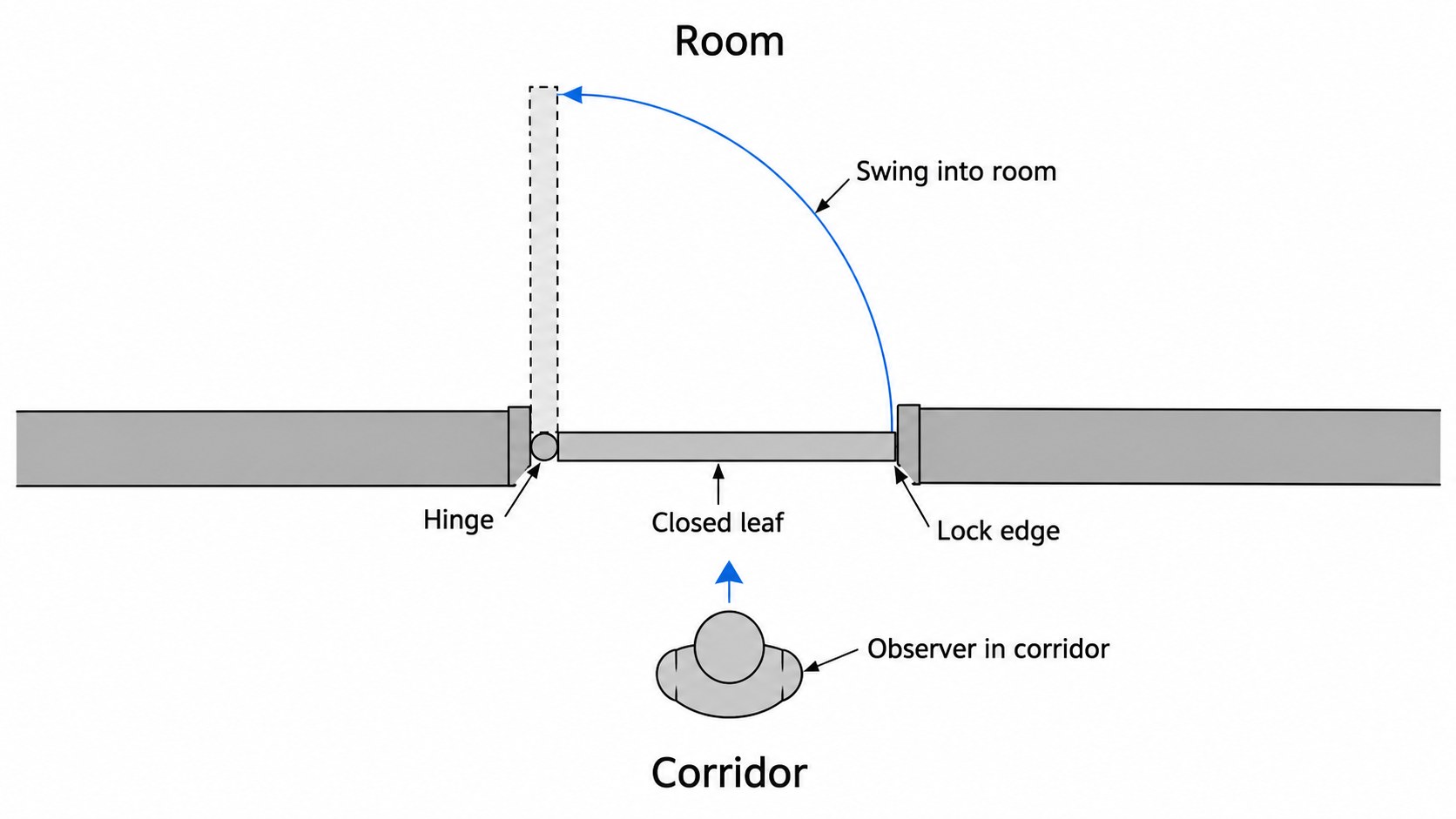
Watch the leaf move instead of reading the swing from a pull handle or keypad position. From the chosen side, a single-action door that moves away is pushed open, and one that moves toward you is pulled open.
For a door that is not installed yet, record the specified swing from the current door schedule or drawing, with the drawing revision. For an existing door, record the observed swing. If the site and the drawing disagree, settle it with the project team before the lock is configured.
5. Why LH, RH, LHR, and RHR Still Need a Convention
Architectural hardware schedules use LH (left hand), RH (right hand), LHR (left hand reverse), and RHR (right hand reverse). The codes are efficient when everyone uses the same viewpoint.
Allegion's quick-reference chart takes its view from the "Outside". Schlage's CS210 service manual uses the "secure side", usually the outside, and then separates standard from reverse swing. [1][2]
Other markets and factories use other systems:
- a North American architectural-hardware convention;
- an internal factory diagram;
- a "left open / right open" convention;
- a lock-body or latch-orientation diagram;
- a product-specific ordering code.
So the order is:
physical description first → handing code second
When a code comes back, such as "RHR", check it against the viewpoint, hinge side and swing you sent.
Inswing and outswing are not LH and RH
"Outswing means reverse" is only true inside a convention with a fixed viewpoint. Record the physical facts first (viewpoint, hinge side, lock edge, swing destination, active leaf) and convert them to a code afterward.
6. Four Single-Leaf Doors, Described in Full
Stand in the corridor and face the closed door. The table shows the four hinge-and-swing combinations, and the code each one gets under the Allegion "Outside" rule when the corridor is the outside. [1]
| Hinge side from corridor | Lock/latch edge | Movement from corridor | Complete description | Code if the corridor is the outside |
|---|---|---|---|---|
| Left | Right | Away, into room | "Viewed from the corridor, hinges left, lock edge right, opens away from me into the room." | LH |
| Right | Left | Away, into room | "Viewed from the corridor, hinges right, lock edge left, opens away from me into the room." | RH |
| Left | Right | Toward observer, into corridor | "Viewed from the corridor, hinges left, lock edge right, opens toward me into the corridor." | LHR |
| Right | Left | Toward observer, into corridor | "Viewed from the corridor, hinges right, lock edge left, opens toward me into the corridor." | RHR |
If the room is the secure side instead, every code changes, which is why the full description travels with the order.
The final order record keeps both:
Physical description: viewed from corridor side, hinges right, lock edge left, opens toward corridor. Configuration: the version and ordering code confirmed for that description and model.
7. Double Doors Need One More Question: Which Leaf Is Active?
A pair of doors needs more than "double door, left hand".
Identify the active leaf used for passage and the leaf that will carry the smart lock. They are usually the same leaf; record both anyway. Describe the inactive leaf separately, or say that both leaves operate independently.
Record:
- the observation side;
- which leaf is active;
- which leaf carries the smart lock;
- hinge side of the active leaf;
- meeting edge between the two leaves;
- opening movement of the active leaf;
- whether the passive leaf has bolts, a keeper, overlap, or another condition that affects the meeting edge.
A straight-on photo of the closed pair plus a photo with both leaves open tells more than any left/right label.
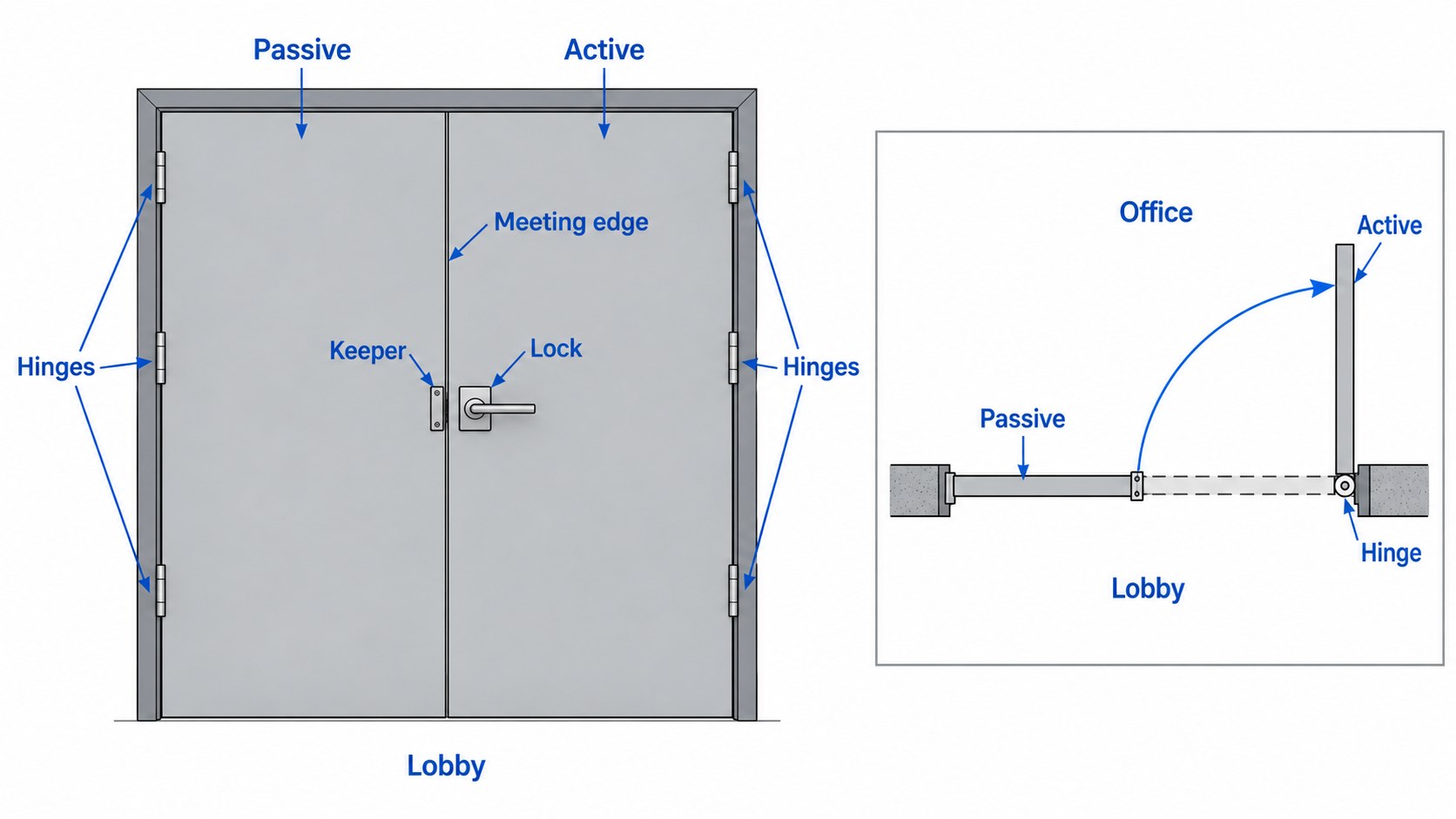
For example: "Viewed from the lobby, the right-hand leaf is the normal passage leaf and will carry the smart lock. Its hinges are at the far right, its lock edge is at the center meeting line, and it opens away from the lobby into the office. The left-hand leaf normally stays closed and receives the latch."
Overlapping or unequal leaves, narrow aluminum profiles and glass clamps affect fit as well as handing, so note them in the same record. Pair-door support also varies by model, so check it before choosing which leaf carries the lock.
8. What to Send to Confirm Door Handing
A handful of photos and one sketch are enough to reconstruct the opening without guessing:
| Evidence | What it should show | Why it matters |
|---|---|---|
| Door ID | One unique opening | Prevents photos from different doors being mixed |
| Full-door photo | Entire leaf and frame from the named side | Establishes viewpoint and overall opening |
| Open-door photo | Leaf partly open, with movement arrow | Shows actual travel direction |
| Hinge close-up | Hinged edge | Confirms the left/right observation |
| Lock/latch-edge close-up | Operating edge and strike/keeper relationship | Cross-checks hinge side and lock edge |
| Marked sketch | Viewpoint, hinge side, lock edge, movement arrow | Removes ambiguity from text |
| Pair-door photo, if applicable | Active/passive leaf and meeting edge | Necessary for double-leaf openings |
| Short video, only if needed | Opening sequence when still photos conflict | Settles a conflict between photos |
Send original, unmirrored photos: a flipped image reverses the hinge side. If a photo conflicts with the written record, retake it from the named side.
Write the viewpoint on the image or sketch itself, and crop out access codes, occupants and any room numbers we do not need for the reply.
With that record and the model you are considering, we return the matching version, handing or ordering code, lock-body orientation and installation drawing. If the model, active leaf or specified swing changes later, send the new details and we check the configuration again.
9. A "Reversible" Smart Lock Still Needs the Handing
Some locks can be set up for either hand. Others use handed latches, trim, lock bodies or installation steps. The Schlage CS210, for example, changes hand with a set procedure for its inside chassis and handing plate. [2]
Reversibility is a property of each model, and the mortise has its own answer even when the front and rear trim reverse. On our G1 apartment smart lock, for example, we record the full mortise designation, strike and handing from one surveyed door in each group, because the body is chosen per door group. Even when a lock can be switched on site, the order still needs the required configuration and the installer still needs the opening description. Follow the model's own instructions for any latch or lock-body reversal.
10. Handing Is Not Permission to Change the Door Swing
A different swing might make installation easier, but the swing belongs to the door, and the lock follows it.
Fire-rated openings, egress routes, accessibility requirements, door closers, adjacent walls and traffic flow all constrain the swing. Identify them during selection. Whether a door can swing another way is for the responsible project professional to decide, especially where life-safety or accessibility requirements apply.
11. Pre-Order Handing Checklist
Before ordering, the handing record should answer:
- Which Door ID is being reviewed?
- From which named side was the door observed?
- Are the hinges left or right from that side?
- Which edge carries the latch/lock?
- Where does the leaf move when it opens?
- Is it a single leaf or a pair?
- If it is a pair, which leaf is active, and which leaf will carry the lock?
- Is there a marked full-door photo or sketch?
- Which model and version is being ordered?
- Has the physical description been matched to the model's handing code and installation drawing?
Frequently Asked Questions
Are inswing and outswing the same as left-hand and right-hand?
No. Inswing and outswing describe which way the door moves. Left and right hand describe which side the hinges are on. A door has both, so record them separately.
What do LH, RH, LHR, and RHR mean?
Viewed from the outside: LH means hinges on the left and the door opens away from you; RH means hinges on the right and opens away; LHR and RHR are the same hinge sides with the door opening toward you. [1][3] On a smart lock order, send the full description with the code.
Is hinge side enough to identify the correct smart lock?
No. The hinge side also needs the observation side, the swing direction, the lock edge, the active leaf on a pair, and the model being ordered.
Can a smart lock be reversed if I get the handing wrong?
Some models can be reversed on site and others need different parts. Reversibility comes down to the lock, lock body and latch arrangement, so give the handing with the order instead of relying on a reversal later.
Keep the Physical Description With the Order
A two-letter code is easy to get wrong when two parties use different conventions. A written description with a matching photo is not:
For example: Viewed from the corridor, hinges left, lock edge right, opens into the room. The marked photo shows the same viewpoint and movement.
Keep it on the order line with the confirmed configuration. Handing is one part of the fit; door thickness, cutout and frame are checked in the compatibility and measurement guide.
References
- Allegion. Door Handing Quick Reference Sheet, one-page chart, “Outside” viewpoint.
- Schlage. CS210 Series Service Manual, p. 15, secure-side observation, standard/reverse handing and model-specific handing adjustment.
- Allegion Knowledge Center. How do I determine the hand of a door?, viewed from the security or key side: away from the viewer LH/RH, toward the viewer LHR/RHR.